
Understanding and speaking are two different skills
There is a particular kind of failure that almost everyone who has studied English for a year or two will recognise.
| Item | Value (%) |
|---|---|
| Read aloud | 76 |
| Read silently | 59.8 |
| Never shown (wrongly recognised) | 21.9 |
The same people read some words aloud and some silently. Afterwards they recognised the words they had said aloud clearly more often. Saying something makes it more memorable than only seeing it, one reason spoken practice beats silent tapping for anything you want to say later.
Source: MacLeod et al. (2010) Experiment 1, 44 university students. The benefit appeared when each person read some words aloud and some silently.
You know the word. You have seen it a hundred times. You would recognise it instantly in a sentence, you would pick it out of four options without hesitating, and you cannot produce it while a person is looking at you waiting for the end of your sentence. So you say something simpler, or you stop.
This has a name worth knowing: the recognition trap. It is not a sign that your English is bad or that you did not work hard enough. It is the predictable result of practising one skill and needing another.
Recognising the right answer and producing the right answer are different operations in memory. Recognition asks "have I seen this before?" and gets help from the thing in front of you. Production asks "what is the word?" with nothing in front of you at all. The second is much harder, and it does not come free with the first. You can strengthen recognition for years and watch production stay exactly where it was.
How to tell whether you are in it
A few signs, and most people who are in the trap recognise three or four of them at once.
- You understand films, podcasts and meetings in English far better than you can take part in them.
- Your written English is noticeably better than your spoken English, because writing gives you time to retrieve.
- You can explain a grammar rule correctly and still break it the moment you are speaking.
- You rehearse sentences in your head before saying them, and by the time one is ready the conversation has moved on.
- You avoid words you know perfectly well, because you are not sure you can say them in time, and you reach for simpler ones instead.
- You have a long streak in a language app and you still go quiet in a meeting.
That last one is the clearest sign, and it is the least fair. The streak is real work. It simply trained a different thing from the one you now need.
Why so much practice trains the wrong thing
Most practice formats are built on recognition, and there is a sensible reason for that: recognition is easy to turn into a tappable exercise. Choosing from four options, matching pairs, dragging words into order, repeating a sentence you were just given. Every one of these can be marked instantly and automatically, and every one of them can be completed without ever generating language yourself.
| Item | Condition | Value (%) |
|---|---|---|
| After 5 minutes | Read once, recalled 3 times | 71 |
| After 5 minutes | Read 3 times, recalled once | 78 |
| After 5 minutes | Read 4 times | 83 |
| After 1 week | Read once, recalled 3 times | 61 |
| After 1 week | Read 3 times, recalled once | 56 |
| After 1 week | Read 4 times | 40 |
Students who reread a passage four times remembered the most after five minutes, and the least a week later. Students who read it once and then tried to recall it three times forgot far less. Pulling words out of your own memory, which is what speaking asks of you, is what made them last.
Source: Roediger & Karpicke (2006) Experiment 2: university students recalling prose passages; share of idea units recalled.
They are genuinely useful. They build vocabulary, they teach you what correct English looks like, and they are pleasant to do on a bus. The trouble is only that they feel like progress towards speaking while mostly building something next to it.
Reading a sentence aloud from a screen has the same limit, one step closer. You are saying the words, which helps, but the words were handed to you. The part that fails in conversation, finding the words while somebody waits, never happens.
There is a quieter cost as well. Recognition practice gives constant small wins, a green tick every few seconds, and that feels like learning in a way that stumbling through a spoken answer does not. So it is natural to drift towards the practice that feels good and away from the practice that works. Knowing the difference is most of the battle: an exercise that makes you slightly uncomfortable, because you have to find the words yourself, is usually the one doing the useful work.
The way out is not more study. It is a different kind of repetition.
What twenty minutes of speaking a day actually does
Not motivational arithmetic. Three specific mechanisms, each of which is a well-established idea in memory research rather than a claim about any product.
| Item | Value (%) |
|---|---|
| Kept being tested | 80 |
| Dropped from tests, still studied | 36 |
| Dropped from tests and study | 33 |
Learners studied foreign-language word pairs. Pairs that kept being tested were remembered about twice as well a week later as pairs that stopped being tested, even when those were still studied. Practising recall, not reviewing, is what held them.
Source: Karpicke & Roediger (2008) University students learning Swahili-English pairs; the paper reports the tested groups together as about 80.
Saying it aloud encodes it better than reading it. Psychologists call this the production effect, named by Colin MacLeod and colleagues after a series of experiments in which simply reading words aloud produced substantially better memory than reading the same words silently. Saying, writing and whispering all beat silent reading; speaking beats all of them. Every minute you spend speaking English is worth more to your memory than the same minute spent reading it, before you count any feedback at all.
Being asked beats being shown. Retrieval practice, also called the testing effect, is the finding that trying to pull something out of memory strengthens it more than reviewing it does, even when the attempt fails. A question you have to answer out loud is retrieval. A multiple choice option you recognise is not.
You get good at the thing you practise, in the conditions you practise it. This is the least intuitive of the three and the one that explains the frozen meeting completely. Memory is sensitive to the match between how you learned something and how you have to use it. Practise under no time pressure, with the words in front of you, and you become good at producing English under no time pressure with the words in front of you. Conversations offer neither.
Twenty minutes a day of spoken answers stacks all three: production, retrieval, and practice conditions that resemble the situation you are actually afraid of. That is the whole argument, and it is why the format of your practice matters more than the content of it.
Why short and daily beats long and weekly
Consistency matters more than length, and not because of willpower.
| Item | Value (%) |
|---|---|
| 20 min | 47.2 |
| 1 h | 37.3 |
| 9 h | 27.6 |
| 1 day | 31.7 |
| 2 days | 23 |
| 6 days | 16.8 |
| 31 days | 4.1 |
A modern replication of Ebbinghaus measured how much faster a list could be relearned after each delay. Most of the benefit is gone within a day or two unless the material is used again, which is why a daily return to speaking matters more than a long session once a week.
Source: Murre & Dros (2015) One adult learning nonsense syllables; "savings" is the share of relearning time saved, not the share remembered.
Speaking is a retrieval skill, and retrieval skills respond to frequency. A path through memory that is used every day stays short and quick to find. The same path used once a week has to be rebuilt each time, and most of the session goes on rebuilding it rather than extending it. Twenty minutes every day is a different intervention from two and a half hours on a Sunday, even though the arithmetic says otherwise.
There is a practical reason too. A long session is easy to postpone and hard to start. A short one is easy to face on a tired evening, and the tired evenings are the ones that decide whether a habit survives its third week.
Speakle · the English practice app for fluency and confidence
One app for everything that gets you speaking
Most apps train one piece: words, sounds or a chat window. Speakle puts the whole road to fluent, confident English in one place, and every part of it ends with you speaking.
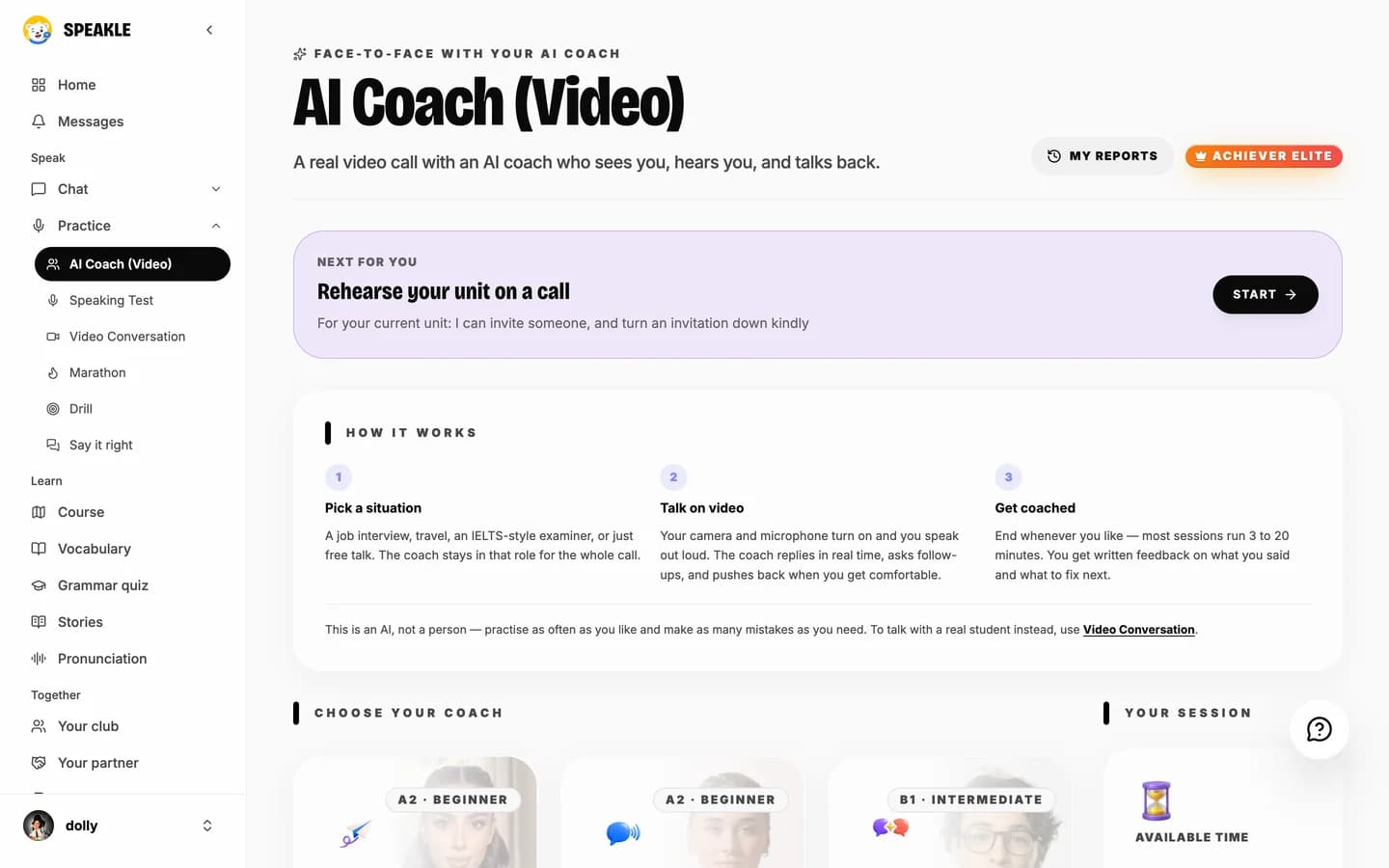 Live coachFace to face with an AI coach, on videoJob interviews, debates, travel, IELTS speaking or an open conversation. The coach stays in role for the whole call and nothing is scripted.
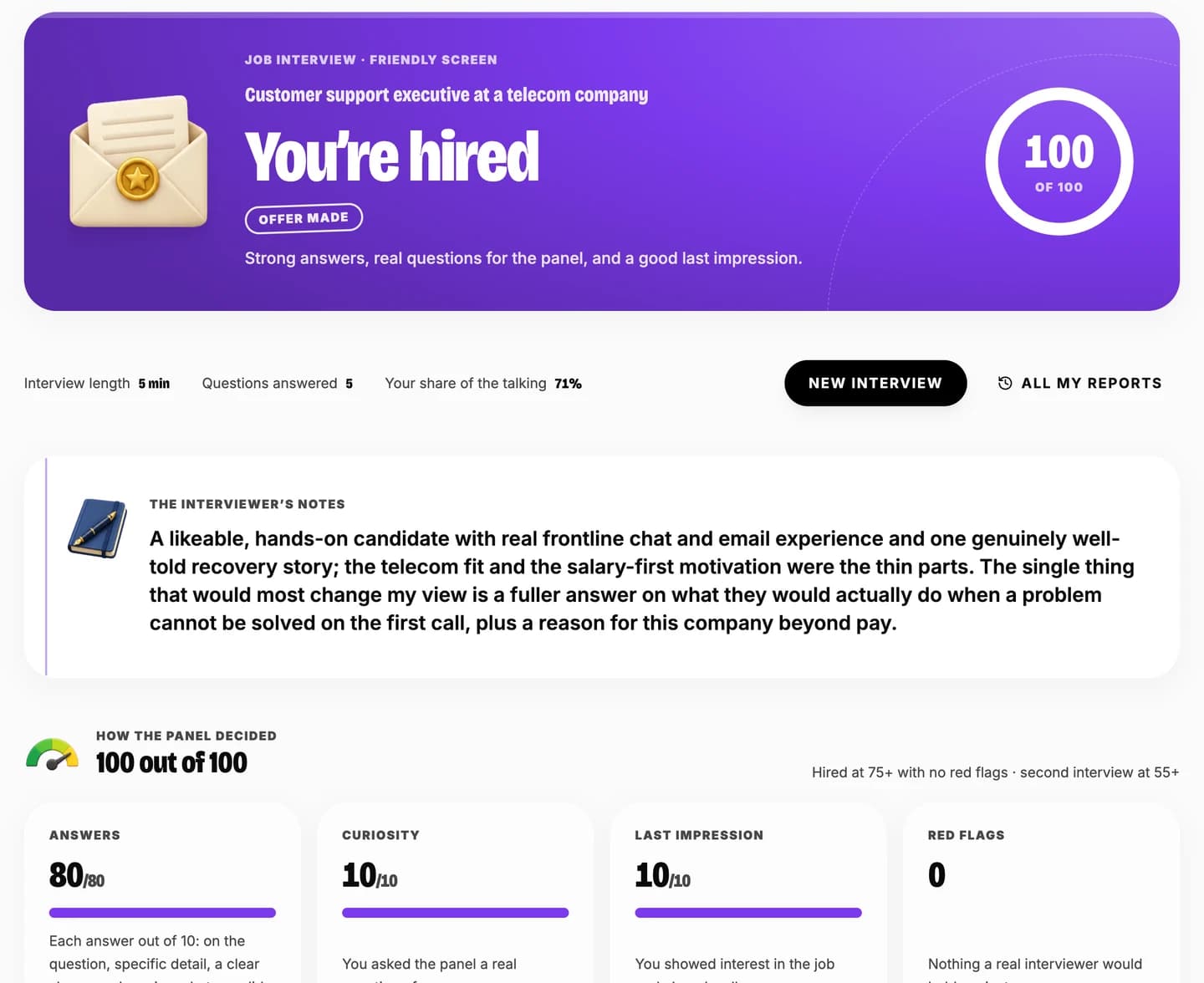 ReportsA report after every callAn interview ends in a hiring decision, a debate is won or lost, a trip earns a stamp at each stop.
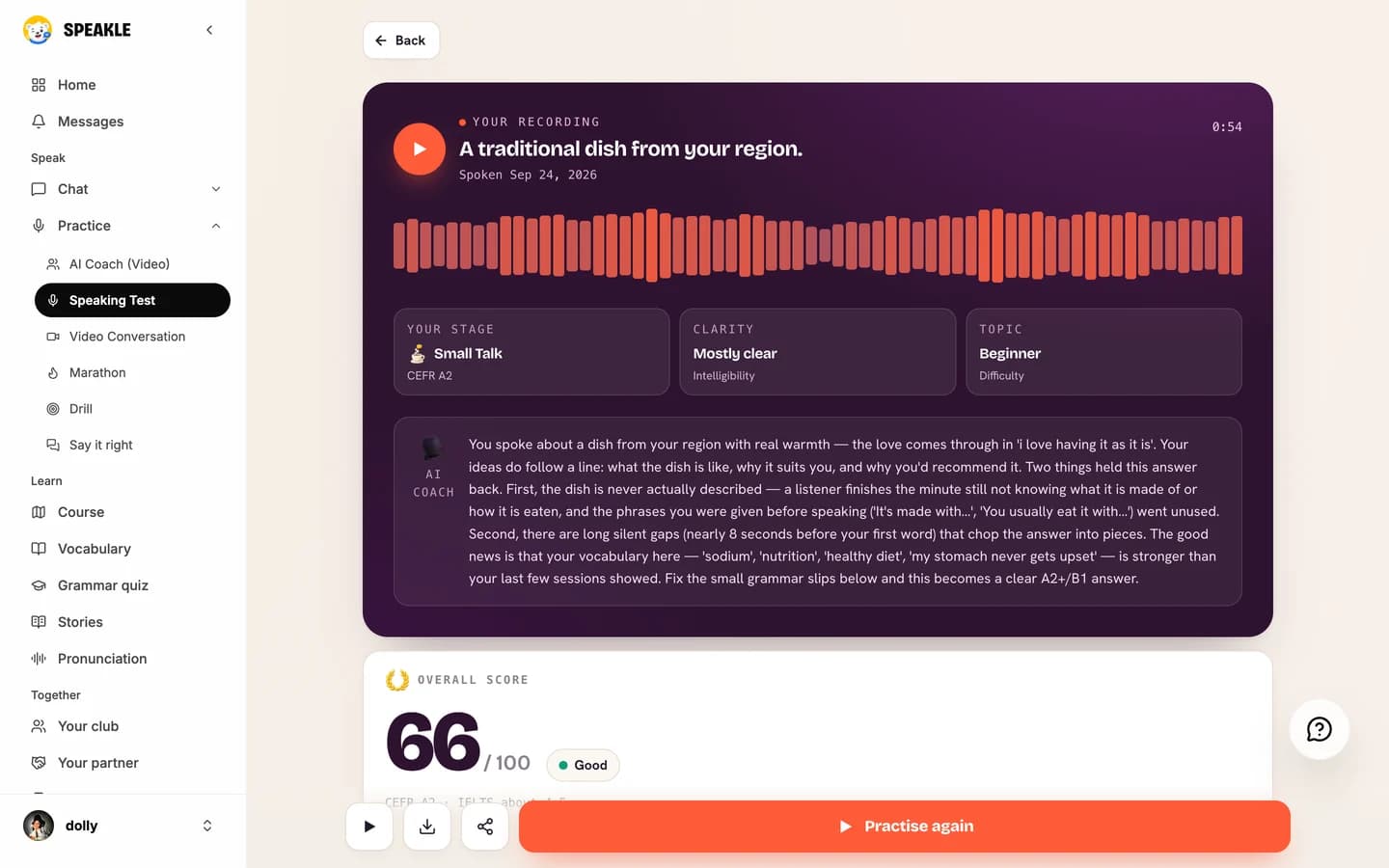 Every sessionYour speaking, measuredPronunciation, fluency, grammar, vocabulary and coherence, with a CEFR level and the one thing to fix first.
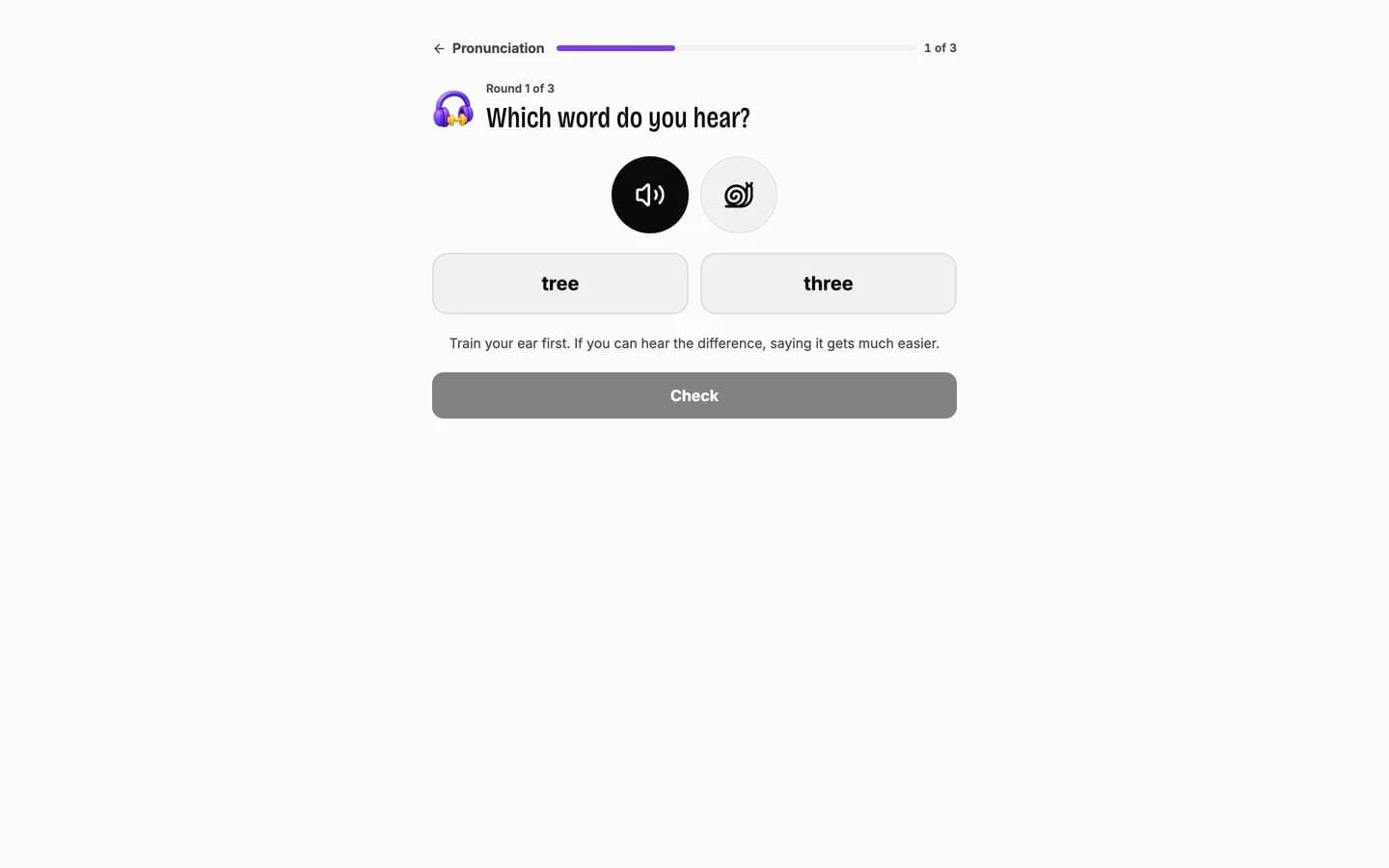 PronunciationPronunciation from your first languageSounds your language merges come first; sounds it already gives you are skipped.
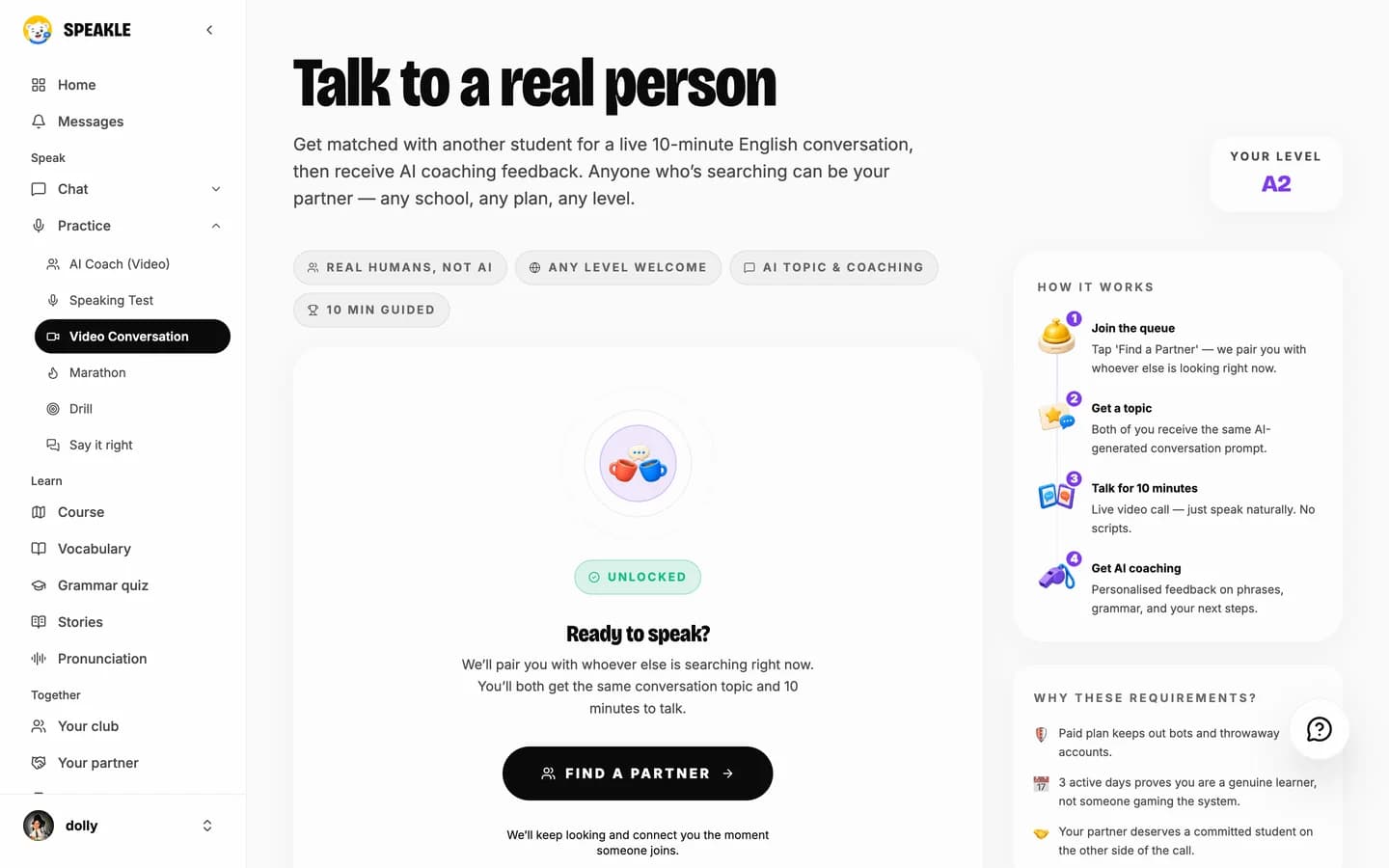 PeopleReal learners, on videoTen minutes with another learner at your level, then coaching on what you both said.
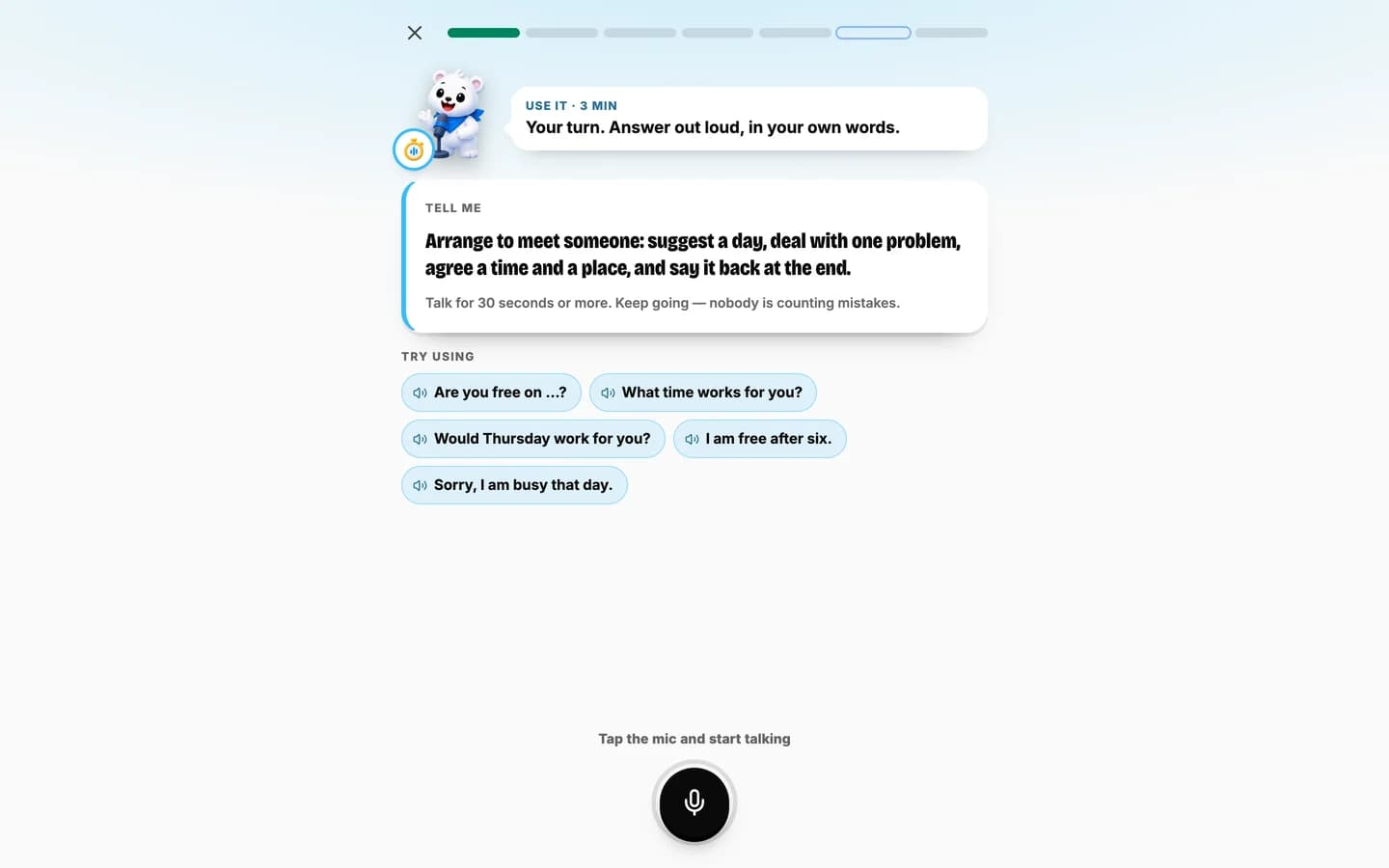 CourseA course where every step is spoken109 units from A1 to C2. Each step is a real task you say out loud, not tiles to tap.
Exercises you can do with no app at all
None of this needs software. These work, cost nothing, and attack the trap directly.
The one-minute answer. Pick an everyday question: what did you do at the weekend, what is your job like, what are you planning for next month. Set a timer for one minute and talk until it ends. Do not stop to correct yourself. The goal is not a good answer, it is an unbroken one.
Narrate what you are doing. Describe out loud whatever you are doing while you do it, making tea, walking somewhere, tidying a room. It feels odd for about two days. It is also the purest production practice available, because there is no script and nobody waiting.
Say it, then say it better. Answer a question once. Then answer the same question again immediately, adding one word or phrase you did not use the first time. The second attempt is where retrieval gets faster.
Keep a list of the words you reached for and could not find. Not the words you do not know: the ones you know and could not produce in time. That list is a precise map of your own trap, and a much better study list than any collection someone else wrote.
Record yourself once a week. Same question, every week, one minute. Keep the recordings. In a month, listening to the first one is the most convincing evidence you will ever get that the practice is working.
How long it takes to climb out
Longer than an advertisement suggests and much less time than most people fear.
| Item | Value (h) |
|---|---|
| A1 | 90 to 100 |
| A2 | 180 to 200 |
| B1 | 350 to 400 |
| B2 | 500 to 600 |
| C1 | 700 to 800 |
| C2 | 1,000 to 1,200 |
Cambridge English estimates that each level takes roughly another two hundred hours of guided learning. The hours vary with the learner and with how much they practise between lessons, which is why a little speaking every day matters more than an occasional long session.
Source: Cambridge English (2026) Cambridge describes these as a guideline only.
In the first couple of weeks of daily speaking the change is not that you sound better, it is that you start sooner. The gap between hearing a question and beginning an answer shrinks, and that gap is where most of the anxiety lives, so closing it feels out of proportion to the effort.
After a few weeks, recoveries get quieter. You still lose words, but you route around them without stopping, and the person you are talking to does not notice anything happened.
Later still, in the topics you have spoken about many times, the English starts to arrive directly rather than through a translation in your head. It happens topic by topic rather than all at once, which is one more reason to talk about ordinary things you will actually need.
Where Speakle fits
Speakle is built around this one problem. Every session is answered out loud rather than by tapping, and scored on the speech you actually produced: pronunciation, fluency, grammar, vocabulary and coherence. The mistakes are kept as rules and brought back on later topics until you get them right unprompted, which is the retrieval part done for you rather than left to a list you have to maintain yourself.
If you want to see where you stand first, the free speaking test takes one spoken answer and needs no account. The English speaking hub has the rest of these guides, and there is a comparison with other English apps if you are deciding what to practise with.
References
- MacLeod, C. M., Gopie, N., Hourihan, K. L., Neary, K. R., & Ozubko, J. D. (2010). The production effect: Delineation of a phenomenon. Journal of Experimental Psychology: Learning, Memory, and Cognition, 36(3), 671-685. doi.org/10.1037/a0018785 Checked 2026-09-26.
- Roediger, H. L., III, & Karpicke, J. D. (2006). Test-enhanced learning: Taking memory tests improves long-term retention. Psychological Science, 17(3), 249-255. doi.org/10.1111/j.1467-9280.2006.01693.x Checked 2026-09-26.
- Karpicke, J. D., & Roediger, H. L., III. (2008). The critical importance of retrieval for learning. Science, 319(5865), 966-968. doi.org/10.1126/science.1152408 Checked 2026-09-26.
- Murre, J. M. J., & Dros, J. (2015). Replication and analysis of Ebbinghaus' forgetting curve. PLOS ONE, 10(7), e0120644. doi.org/10.1371/journal.pone.0120644 Checked 2026-09-26.
- Cambridge University Press & Assessment. (2026). Guided learning hours. Cambridge English Support Site. support.cambridgeenglish.org/hc/en-gb/articles/202838506-Guided-learning-hours Checked 2026-09-26.