
Knowing English and speaking it are two different skills
Many people who learned English at school, at university or through work end up in the same place. They can read an email, follow a film with subtitles and write a careful message. Then someone asks a simple question out loud, and the words disappear.
| Item | Value (wpm) |
|---|---|
| Speaking time only | 236 |
| Whole conversation | 196 |
| Turn by turn | 164 |
Across 2,438 recorded phone calls between native speakers, the rate ranged from about 164 to 236 words a minute depending on whether pauses are counted. Real conversation is fast, and it does not wait for a sentence you are building in your head.
Source: Yuan, Liberman & Cieri (2006) Native speakers of American English on the telephone, not learners.
This is not a contradiction. Reading and listening give you time. You can pause, reread and look something up. Speaking gives you none of that. You have to choose words, build a sentence, pronounce it and follow the reply, all at once and in real time. If most of your English practice has been silent, the speaking part has had little exercise.
Speaking can be trained in the same way your other English skills were. It needs its own practice, and that practice has to happen out loud.
Why people who know English still freeze
Freezing usually has less to do with missing vocabulary than with pressure. When you worry about how you sound, part of your attention goes to watching yourself, and there is less left for finding words. A small mistake then feels bigger than it is, which makes the next sentence harder.
| Item | Value (%) |
|---|---|
| Panic when speaking without preparation | 49 |
| Do not feel confident when speaking | 47 |
| Get nervous and confused when speaking | 33 |
| Self-conscious speaking in front of others | 28 |
In the study that introduced the Foreign Language Classroom Anxiety Scale, about half of the students said they panic when they have to speak without preparation. Freezing when you speak is common, and it is about the situation, not about how much you know.
Source: Horwitz, Horwitz & Cope (1986) A pilot group of 75 university students of Spanish in the United States.
A few things tend to make it worse:
- Practice that was always graded. If every time you spoke English someone was marking it, speaking starts to feel like a test.
- Few chances to speak. In a class of twenty or thirty people, each person may say only a few sentences in a lesson.
- Comparing yourself with native speakers. The goal slowly shifts from being understood to sounding perfect, and nobody reaches perfect.
- High-stakes first attempts. A job interview or a meeting with a new client is a hard place to start practising.
If this sounds familiar, our guide on why speaking English feels scary, and what helps goes into more detail, including what to do in the moment your mind goes blank.
What builds speaking confidence
Confidence is not a personality trait that you either have or lack. For most learners it grows out of four things.
Speaking often, in short sessions. Five minutes of speaking on most days does more than one long session a week. Each time you speak and nothing bad happens, the next time gets a little easier.
A safe place to get things wrong. Early practice should cost you nothing. Talking to yourself, recording voice notes, or practising with a patient partner or an AI coach removes the audience while you build the habit.
Feedback that is specific and small. "Your English is good" does not help, and a list of twenty corrections is overwhelming. One clear thing to fix, explained in words you understand, is something you can act on tomorrow.
Rehearsing the situations that matter to you. If you are nervous about introducing yourself at work, ordering food on holiday or talking with your partner's family, practise those exact conversations several times before they happen.
Our step-by-step guide on how to build confidence speaking English turns these four ideas into a plan you can follow over a few weeks.
A five-minute daily routine
You do not need much time. A short routine you keep up will carry you further than an ambitious plan you drop after a week. This one works at most levels:
| Item | Value (%) |
|---|---|
| Spaced practice | 47.3 |
| Massed practice | 36.7 |
Across hundreds of experiments, material practised in spaced sessions was recalled better than the same practice crammed into one sitting. Five minutes a day is spaced practice by design.
Source: Cepeda et al. (2006) Averages across many different studies of verbal recall, not a single experiment.
- Warm up for one minute. Describe out loud what you can see around you, or what you did this morning. Keep going even if a sentence comes out wrong.
- Answer one question for sixty seconds. Choose something ordinary: your favourite meal, your last weekend, a place you would like to visit, or what your job involves. Try not to stop.
- Listen back, or get feedback. Notice one thing only: a word you searched for, a sound that was unclear, or a sentence you would now say differently.
- Say it again. Answer the same question a second time, using what you noticed. The second attempt is almost always smoother, and feeling that difference is part of the point.
If you record yourself, keep your first recording. Hearing it again after a month is one of the most convincing ways to notice how far you have come.
Speakle · the English practice app for fluency and confidence
One app for everything that gets you speaking
Most apps train one piece: words, sounds or a chat window. Speakle puts the whole road to fluent, confident English in one place, and every part of it ends with you speaking.
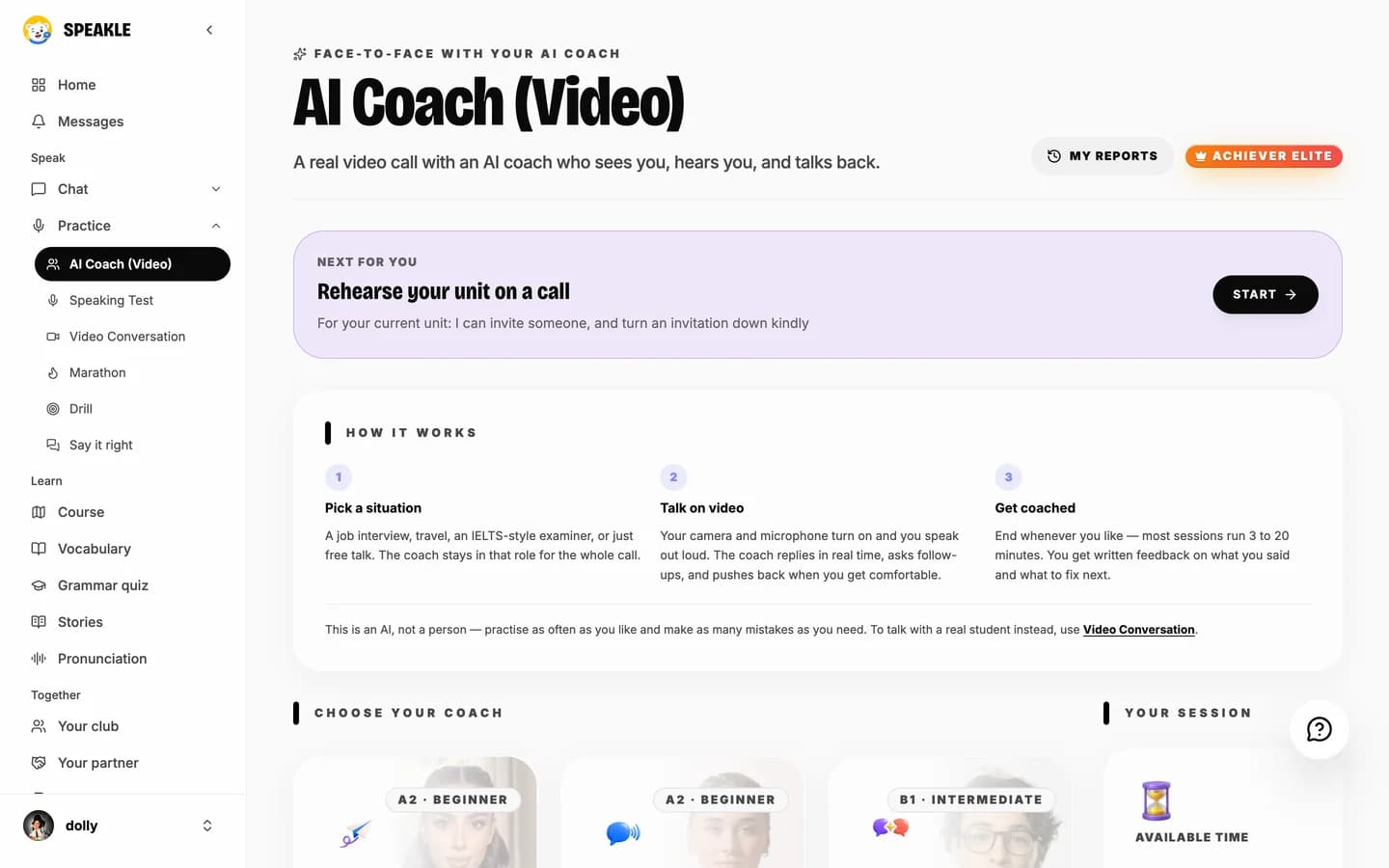 Live coachFace to face with an AI coach, on videoJob interviews, debates, travel, IELTS speaking or an open conversation. The coach stays in role for the whole call and nothing is scripted.
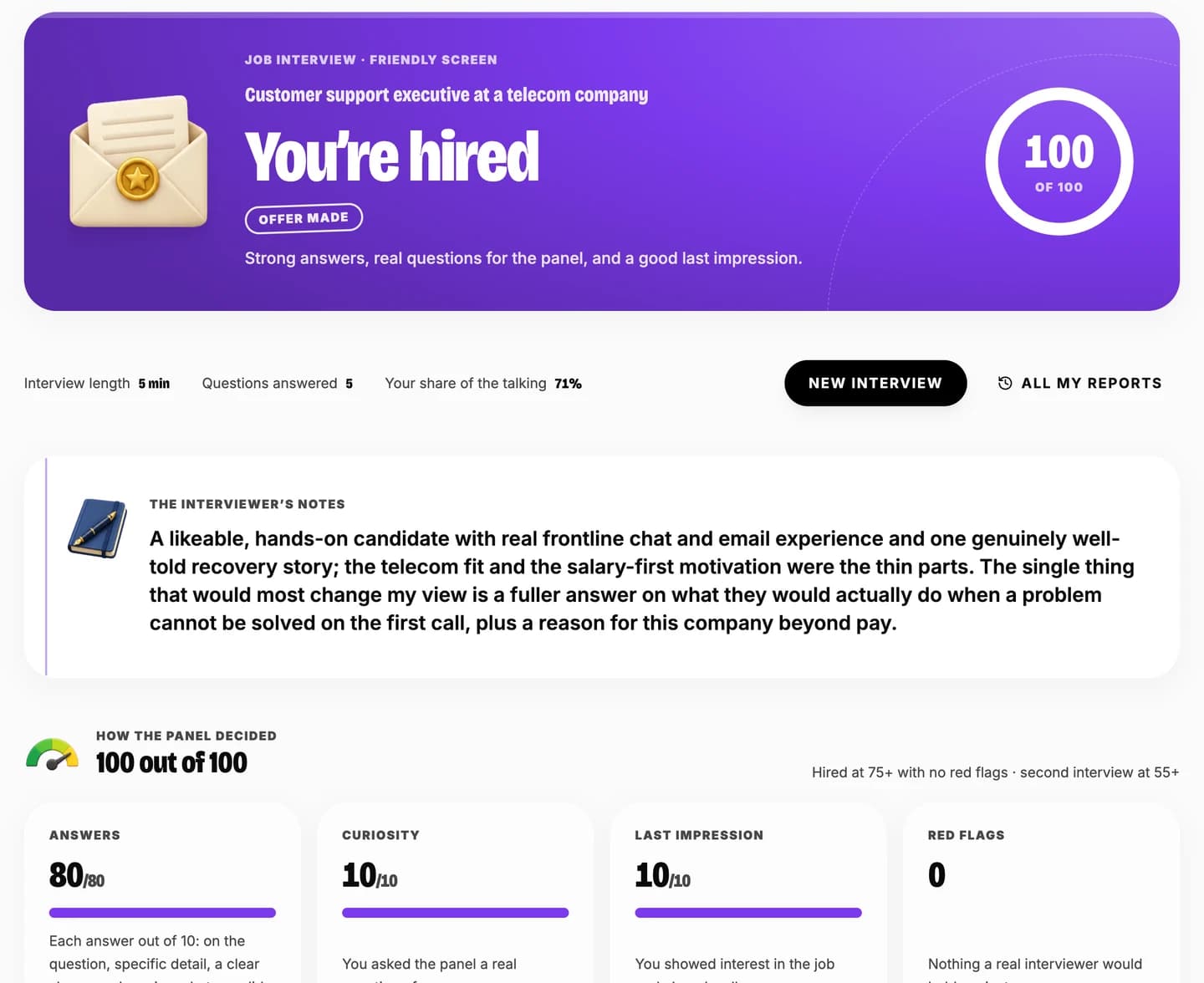 ReportsA report after every callAn interview ends in a hiring decision, a debate is won or lost, a trip earns a stamp at each stop.
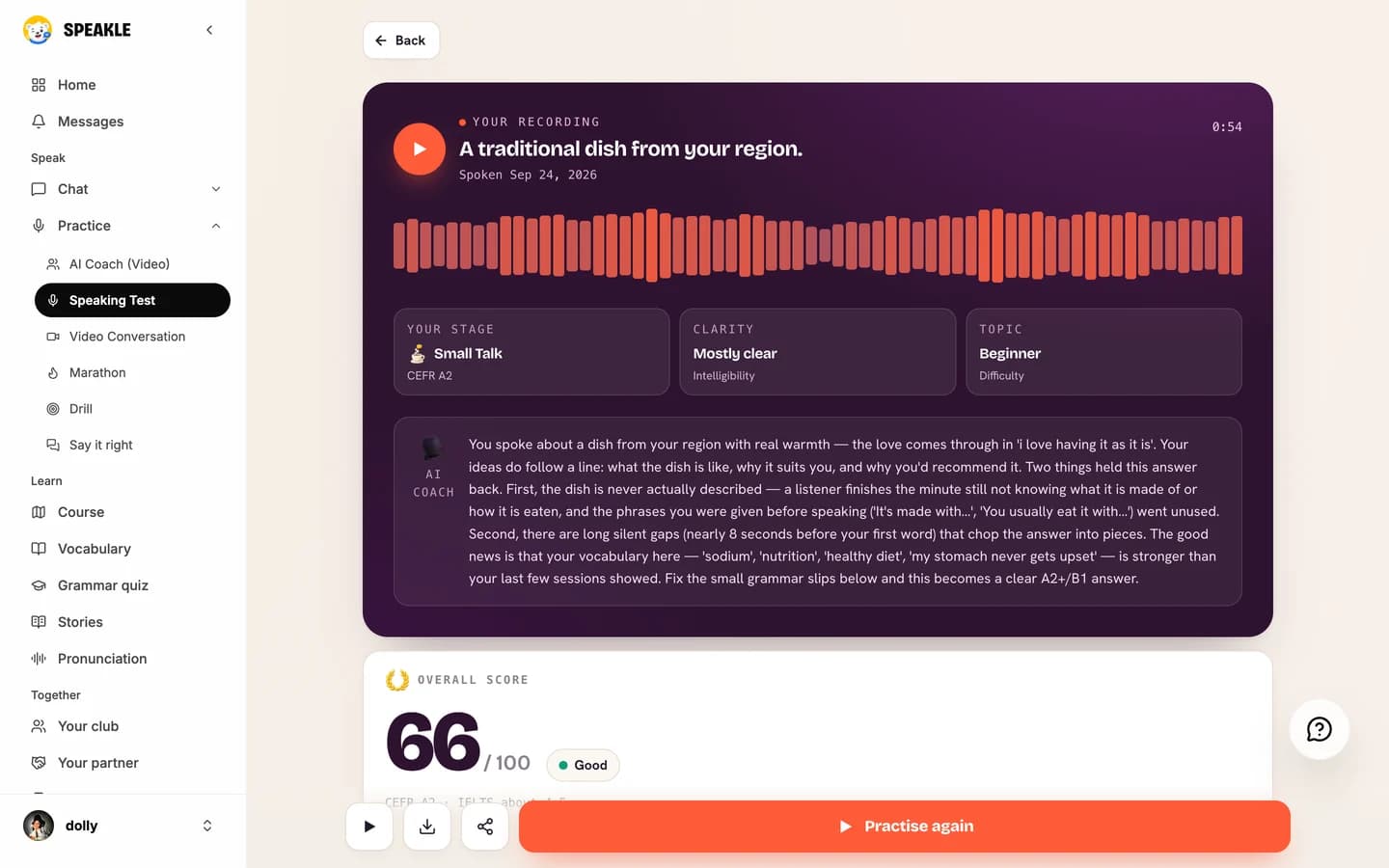 Every sessionYour speaking, measuredPronunciation, fluency, grammar, vocabulary and coherence, with a CEFR level and the one thing to fix first.
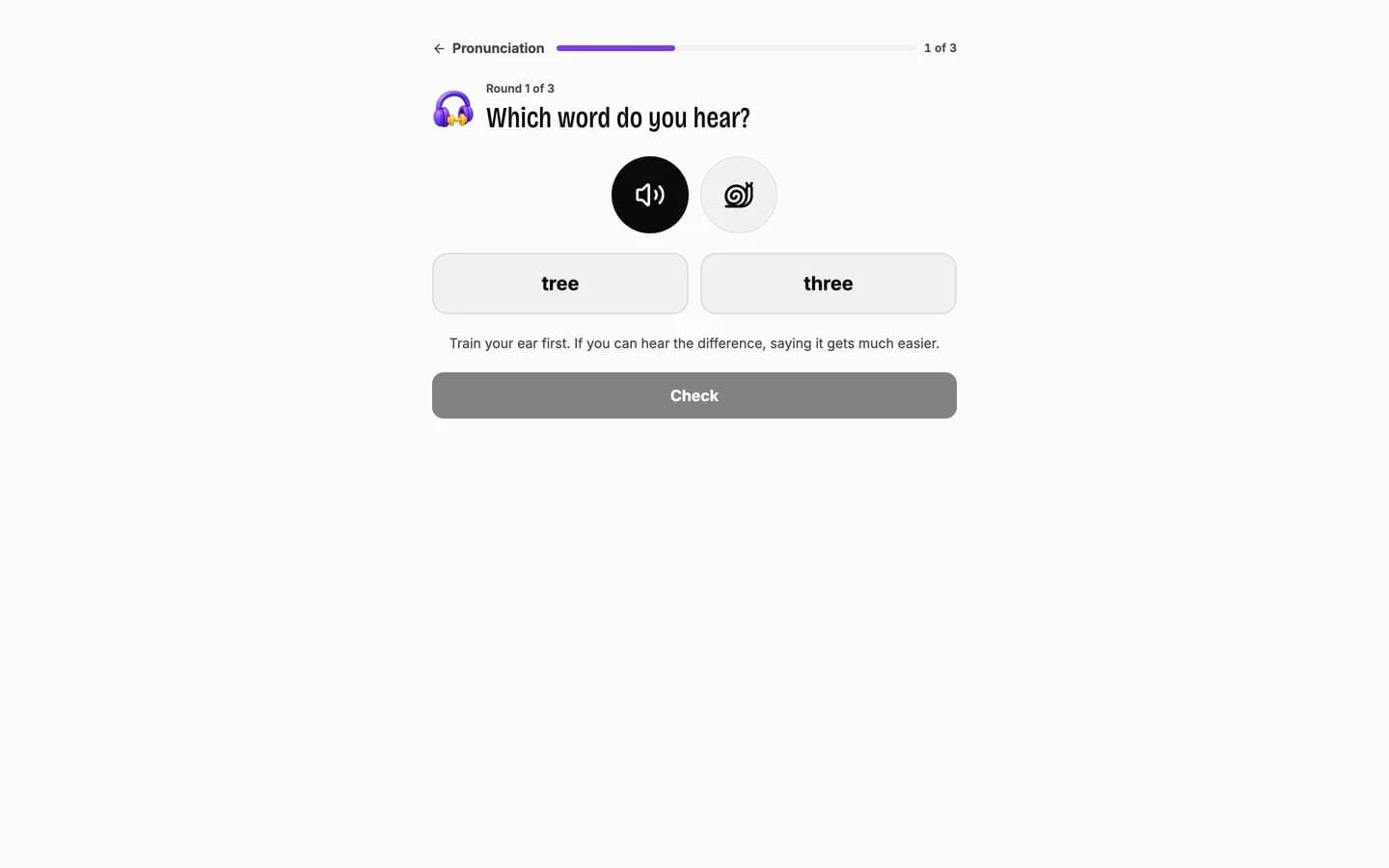 PronunciationPronunciation from your first languageSounds your language merges come first; sounds it already gives you are skipped.
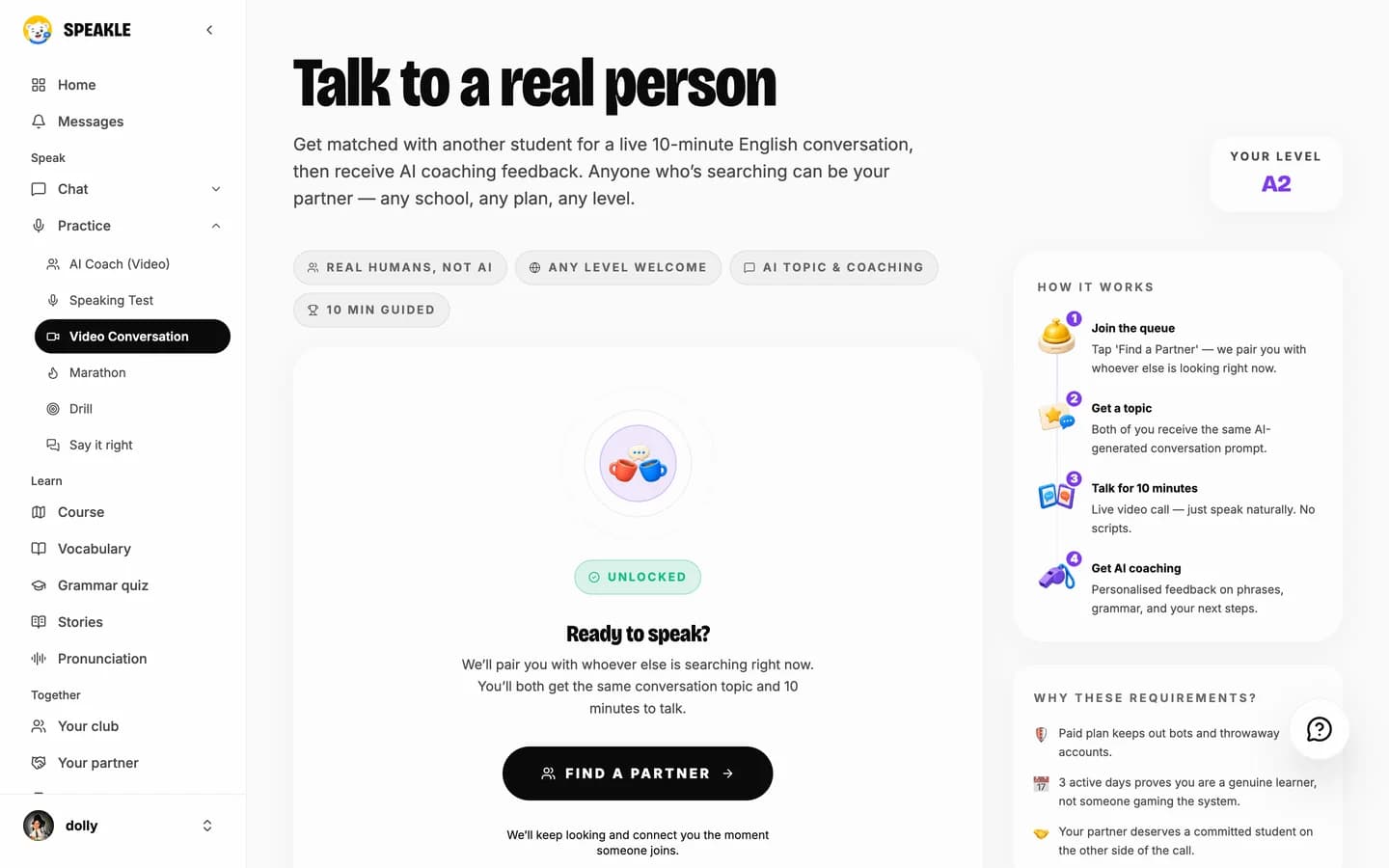 PeopleReal learners, on videoTen minutes with another learner at your level, then coaching on what you both said.
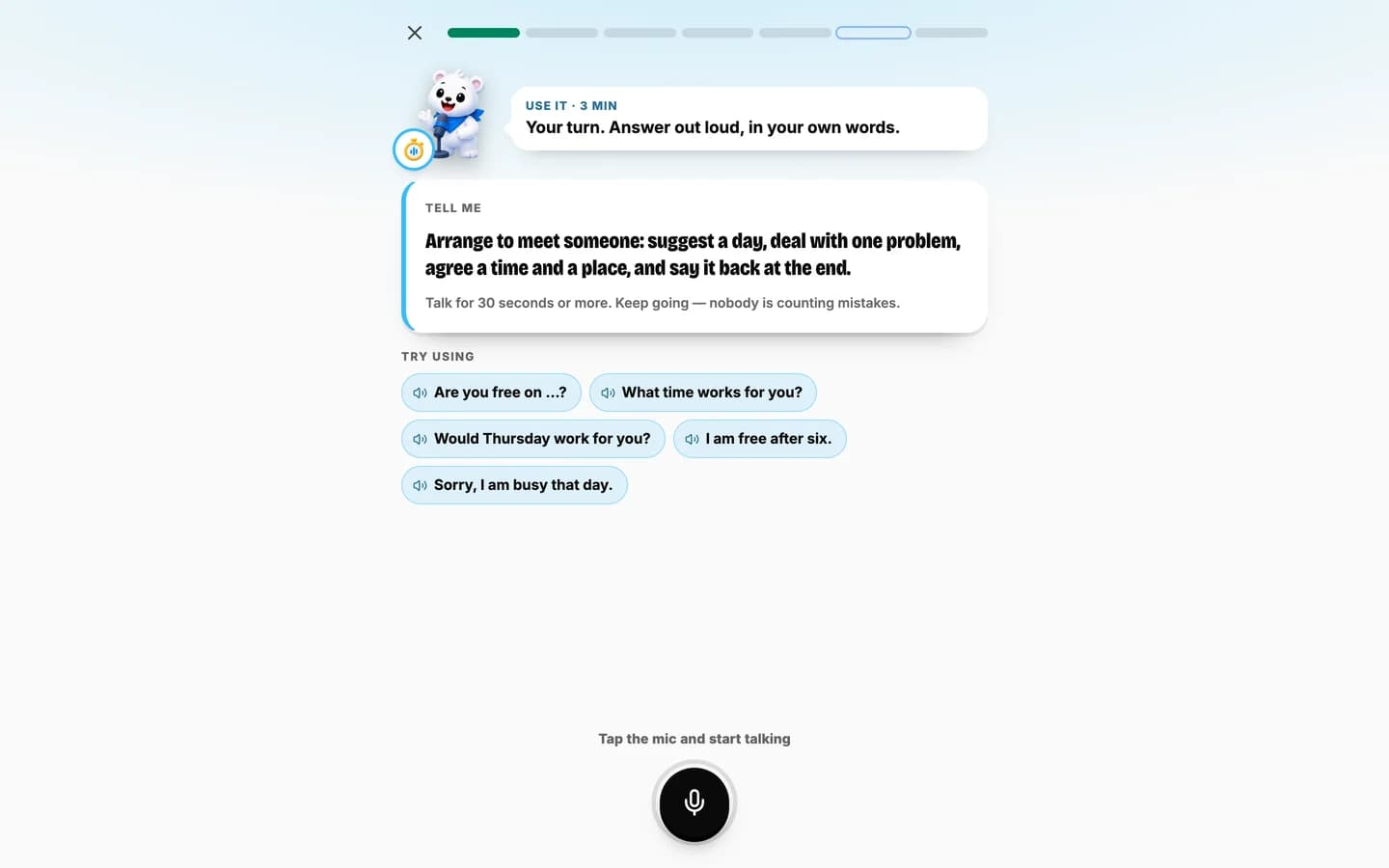 CourseA course where every step is spoken109 units from A1 to C2. Each step is a real task you say out loud, not tiles to tap.
Ways to practise speaking, compared
There is no single right way to practise. Each option suits a different stage, schedule and budget.
| Way to practise | What it does well | What to watch for |
|---|---|---|
| Speaking alone and recording yourself | Free, private and available any time | Nobody tells you what to fix |
| Language exchange with another learner | Real conversation, often free | Can feel exposing, and feedback is informal |
| Classes or a private tutor | Expert, personal feedback | Costs more, needs scheduling, and group classes leave little speaking time each |
| AI speaking coach | Private, patient, available any time, with specific feedback | Scores are estimates, not official exam results |
Many learners combine them: private practice on most days, and conversations with people once speaking feels less frightening.
How Speakle fits in
Speakle is an AI English speaking coach built for the stage where you know English and want to speak it with confidence. You answer a question out loud and get a report that starts with what went well and names one thing to work on, with explanations in your own language if you want them. You choose how much correction you see: light, balanced or strict.
If you are curious how the scores are produced, how Speakle scores your speaking explains what is measured, which technology does each part, and where the limits are.
Guides in this series
- Why speaking English feels scary, and what actually helps: what is happening when you freeze, why it is so common, and practical ways to lower the pressure.
- How to build confidence speaking English, step by step: a four-week plan built on short daily speaking, useful phrases, rehearsal and hearing your own progress.
- Why you understand English but freeze when you speak it: recognising English and producing it are different skills, why most practice trains only the first, and exercises that train the second.
- What an AI English tutor can and cannot do for you: what the technology is genuinely good at, what it is still bad at, and the five questions worth asking before you pay for one.
- How to practise for a job interview in English: the six questions that come up almost everywhere, and a week of rehearsal done out loud rather than in your head.
- How to improve your English pronunciation: the four things that actually stop people understanding you, and why the language you already speak decides your list of sounds.
- English speaking test questions, A1 to C2: practice questions for every CEFR level, with a model answer, useful phrases and one tip for each, and a routine for practising them out loud.
- Free English speaking test: answer one question out loud and get an estimate of your current speaking level.
References
- Yuan, J., Liberman, M., & Cieri, C. (2006). Towards an integrated understanding of speaking rate in conversation. Proceedings of Interspeech 2006. ISCA. doi.org/10.21437/Interspeech.2006-204 Checked 2026-09-26.
- Horwitz, E. K., Horwitz, M. B., & Cope, J. (1986). Foreign language classroom anxiety. The Modern Language Journal, 70(2), 125-132. doi.org/10.1111/j.1540-4781.1986.tb05256.x Checked 2026-09-26.
- Cepeda, N. J., Pashler, H., Vul, E., Wixted, J. T., & Rohrer, D. (2006). Distributed practice in verbal recall tasks: A review and quantitative synthesis. Psychological Bulletin, 132(3), 354-380. doi.org/10.1037/0033-2909.132.3.354 Checked 2026-09-26.