
Who Speakle is for
You understand English. You can read an article, follow a film, pass a grammar test. Then someone asks you a question out loud and the words are suddenly not there.
That gap between understanding and speaking is what Speakle is built to close. Everything on this page is the same idea in different clothes: you answer out loud, you are told one specific thing to fix, and you go again. Nothing here is finished by tapping the right option, because tapping is exactly the practice that lets you stay silent.
It works on a bad day too. The smallest session is one minute, and most people start with the free speaking test, which needs no account and takes about as long as making a cup of tea.
See exactly where you stand, in about a minute
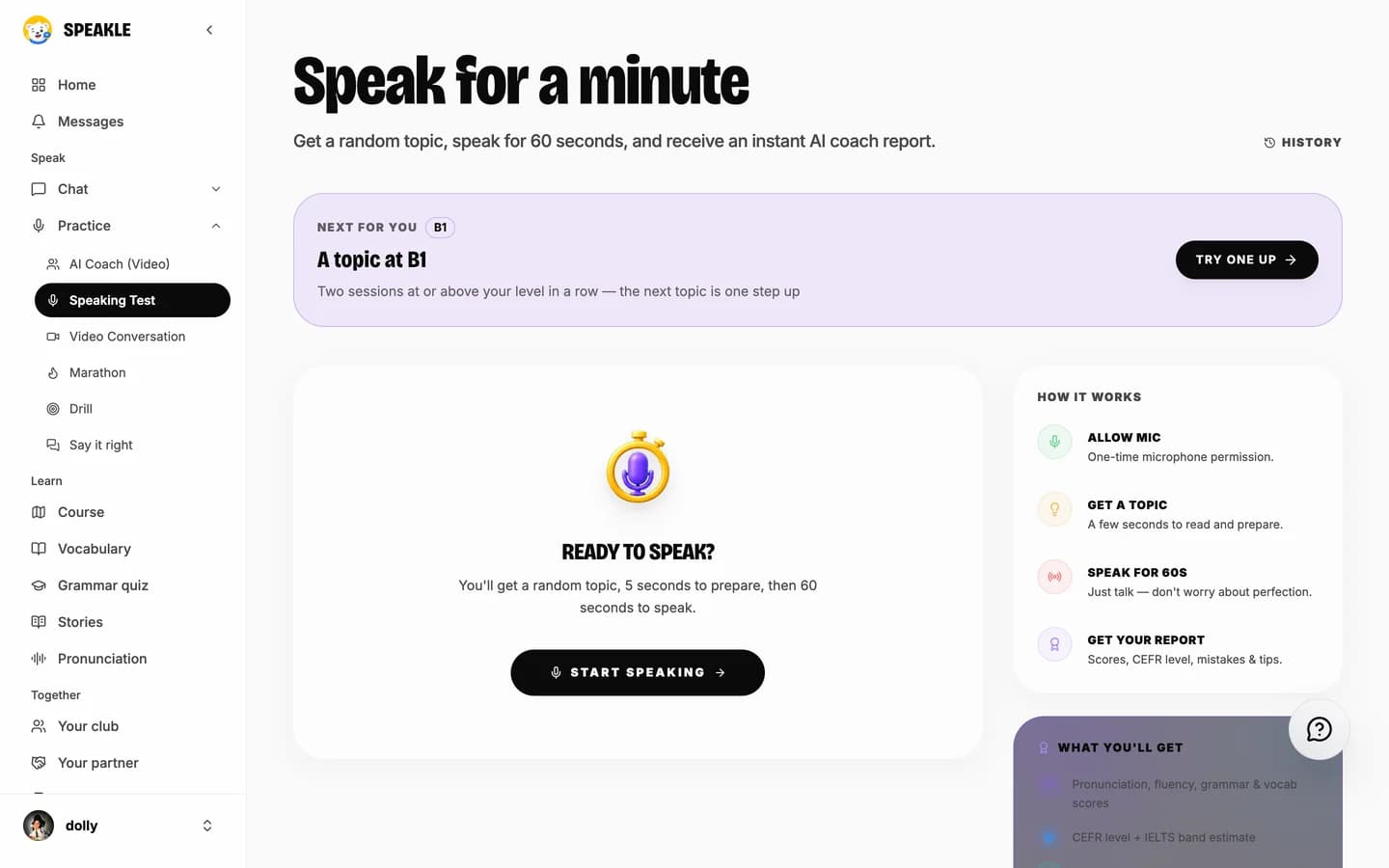
Before anything else, a short spoken level check places you. You answer a question out loud for about a minute and get a report on pronunciation, fluency, grammar, vocabulary and coherence, with a CEFR level and an IELTS speaking estimate.
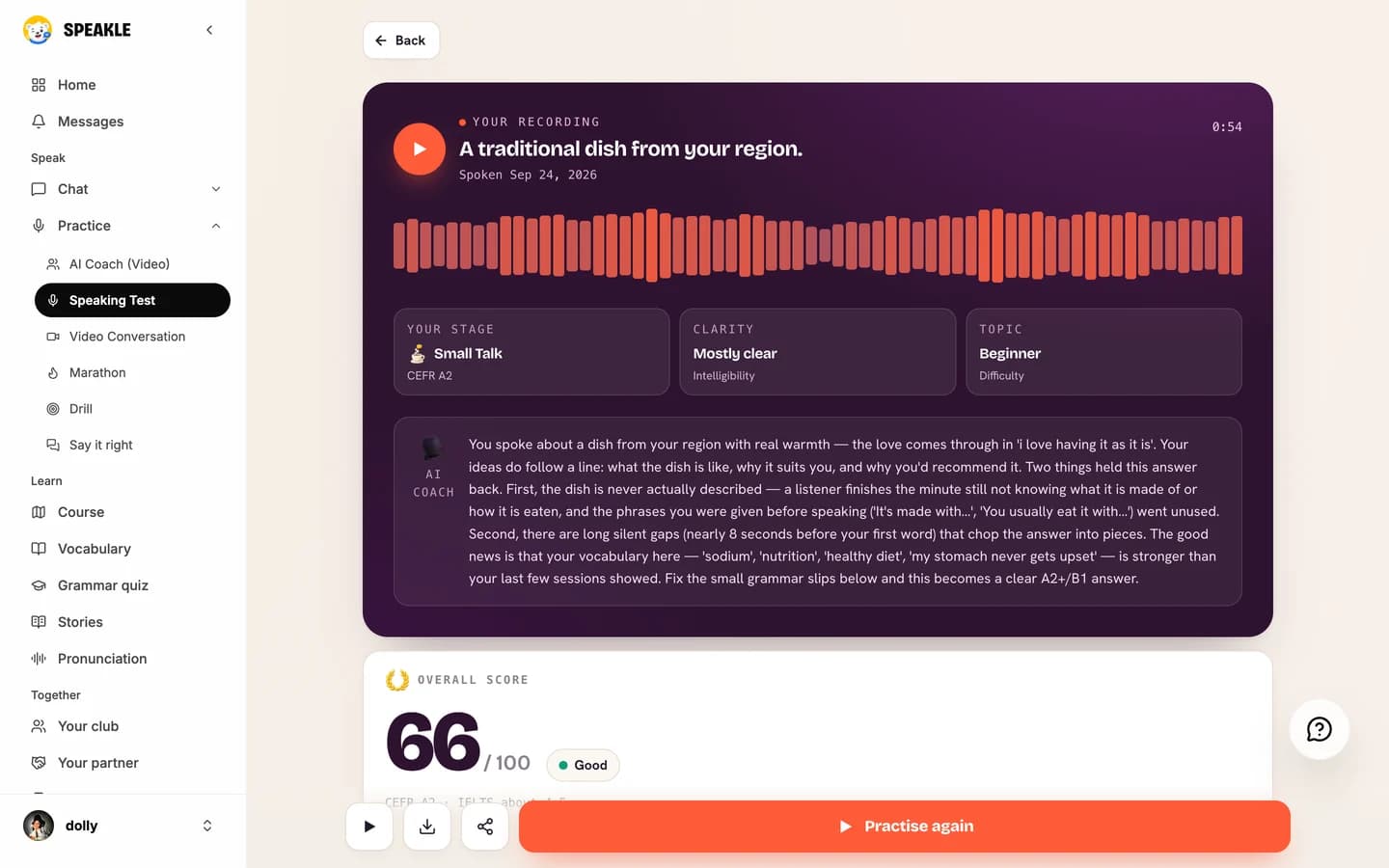
The level matters less than the breakdown. "You are B1" is not something you can act on tomorrow. "Your grammar is ahead of your fluency, and you pause longest at the start of an answer" is.
A daily plan that fits a tired evening
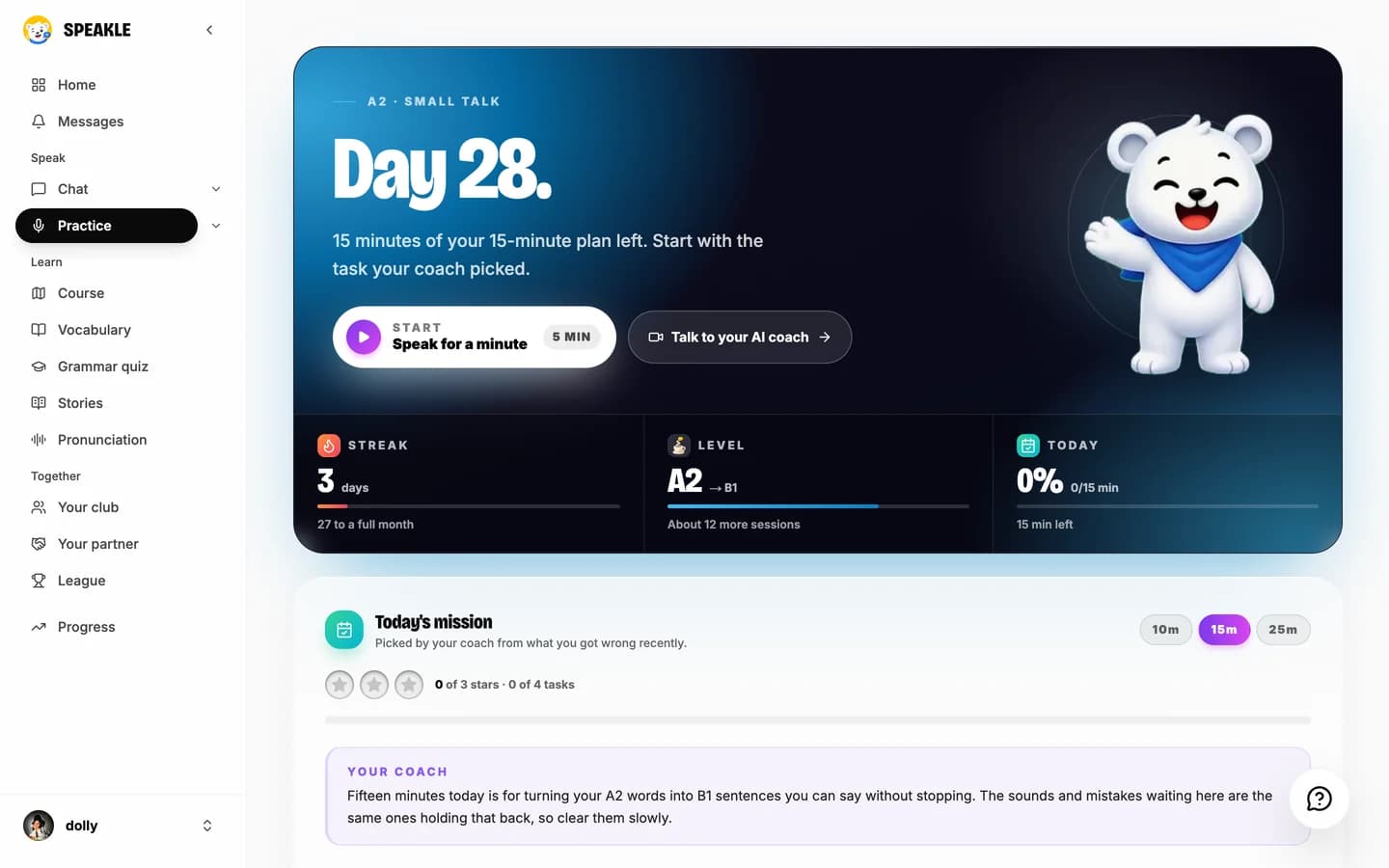
The core habit is deliberately small: one topic, one minute, one report. It is short because a practice you can face when you are tired is worth more than a thorough one you skip. On a better day your plan stretches to ten, fifteen or twenty-five minutes, and the next task is always picked for you from what you got wrong recently.
Every mistake found in a session goes into a record that never resets. What is stored is not the sentence you got wrong but the rule behind it, so it can be tested on any topic. Later sessions quietly check it: did you get it right, repeat it, or avoid it? A mistake is only cleared when you have produced the right form three times, on topics you were not expecting.
Each mistake also carries a confidence flag. Speech recognition is less accurate on accented English, so when a correction depends on words that came back uncertain, you are shown it but it never counts against your score. Being marked wrong for something you did not say is worse than missing a real error, so the tie goes to you.
Face to face with an AI coach, on video
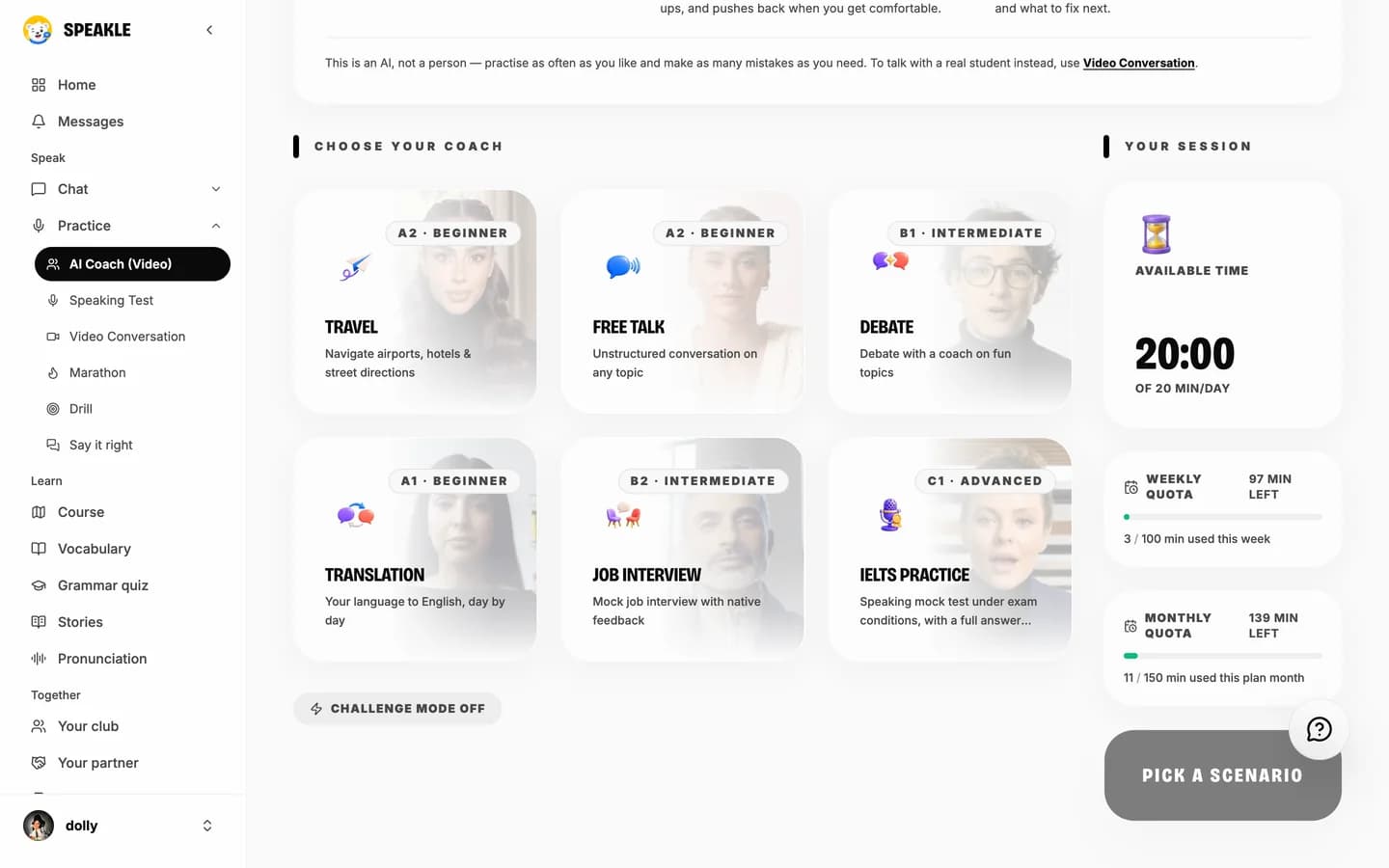
The live AI coach takes the other side of a real conversation, on video, answering in real time. Pick the situation you are dreading: a job interview, a debate, checking in at an airport, translating from your own language, an IELTS speaking test, or just an open conversation. The coach stays in that role for the whole call, and nothing is scripted.
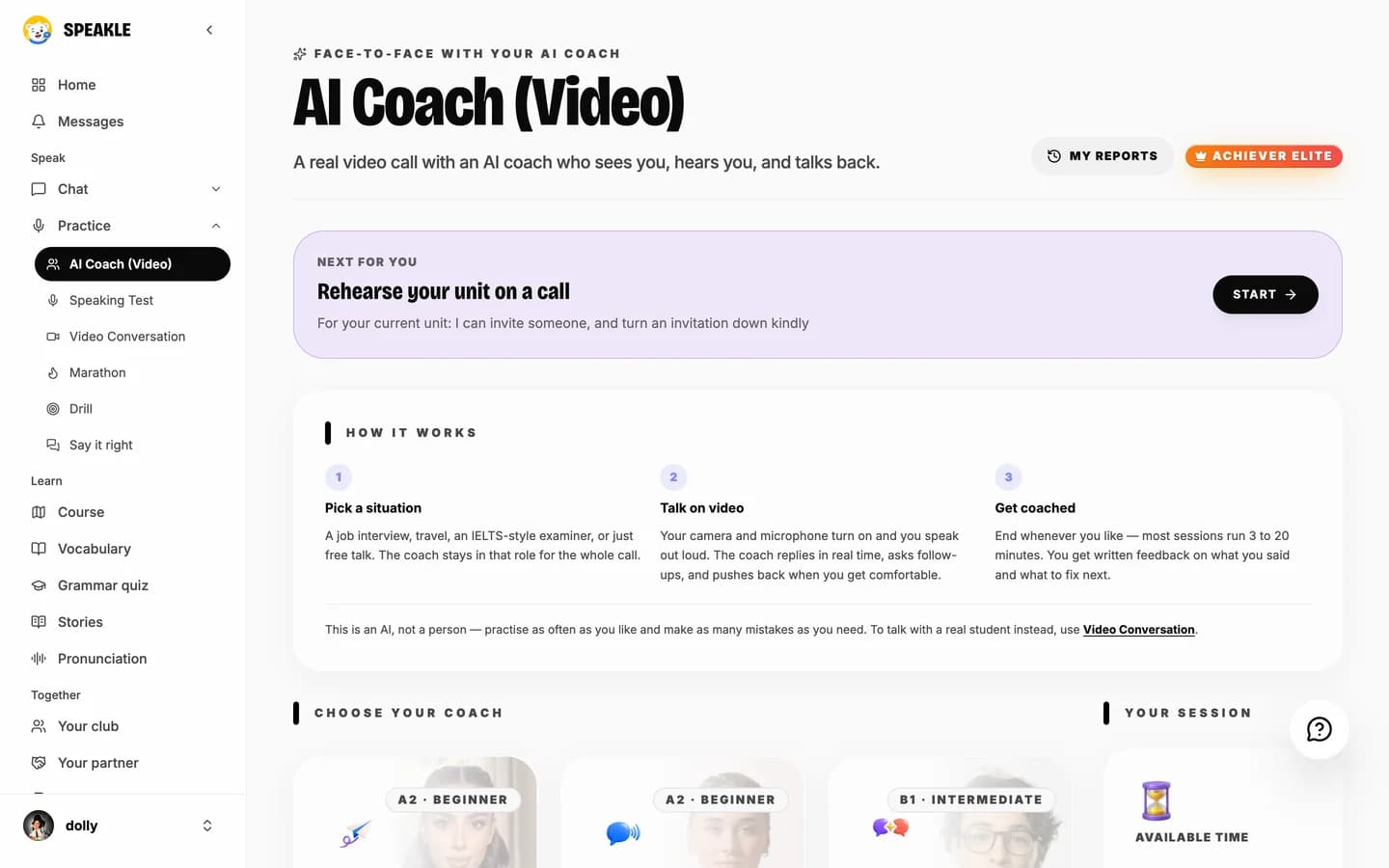
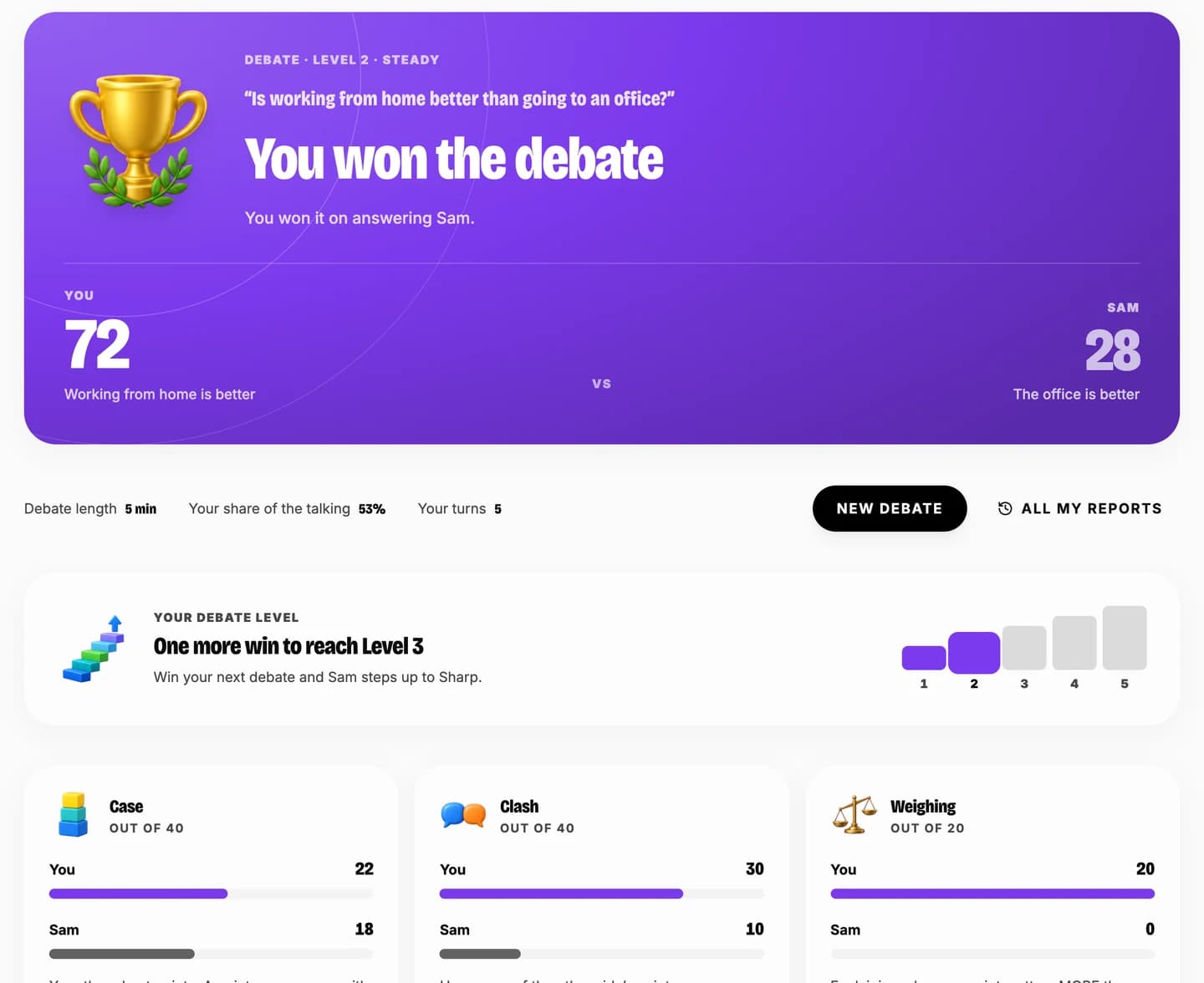
It also gets harder as you do. Each kind of call has its own level that you are never told about during the call: win two debates and your next opponent is sharper, do well in two interviews and the next interviewer pushes harder. If you go blank, one tap shows three ways to say what you mean, with the meaning in your own language.
Rehearse mode goes one step further, and it is the feature people come back for. Describe the conversation you actually have coming up, the role, the organisation, the question you are afraid of, and Speakle builds that specific conversation for you to run as many times as you like.
A report after every live call
Every call with the live coach ends with a report built for that kind of conversation, not a generic score sheet. They follow the same three rules. Every line quoted back to you is something you actually said. The result is worked out by fixed rules from what happened in the call, not from a general impression. And nothing in them judges your grammar or pronunciation, because they are read from a transcript; the speaking test listens to your own voice for that.
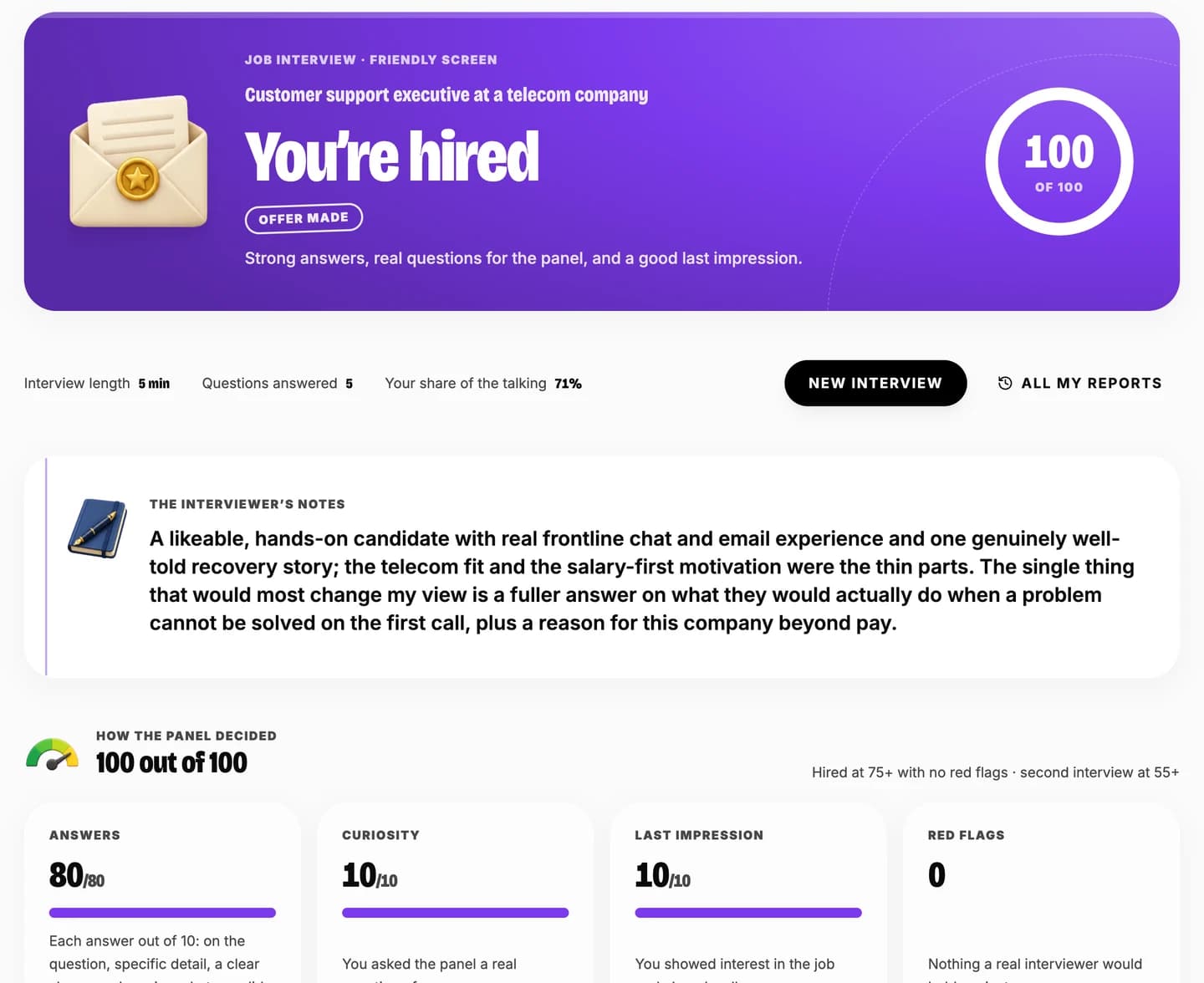
A job interview that ends in a decision
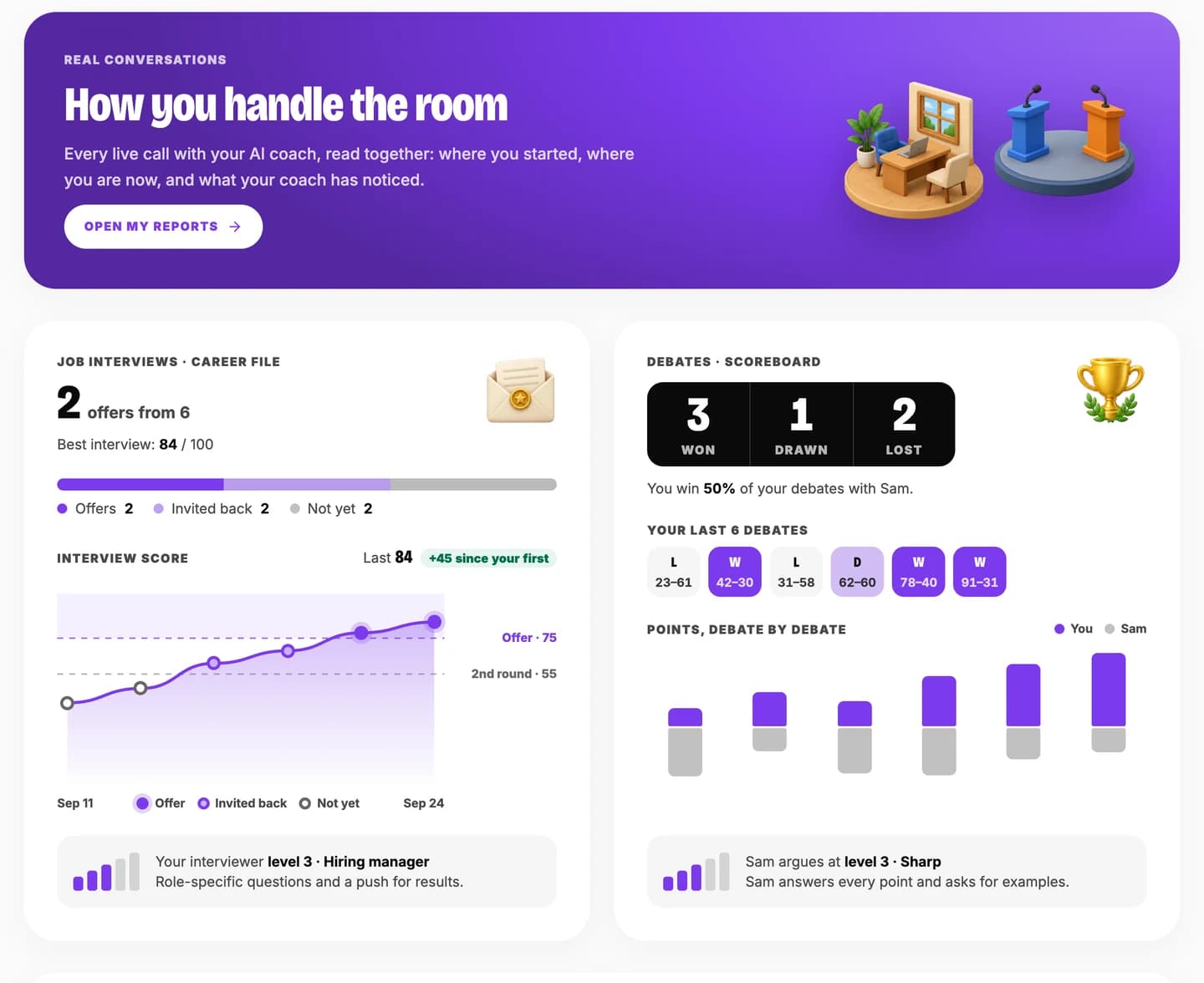
The interviewer stays in role for the whole call: no hints, no coaching, no "great answer". Afterwards you get the decision a real panel would reach (hired, invited back, or not this time) and how it got there. Every question comes back with a stronger version of your answer, along with the red flags a recruiter would notice and the stories worth keeping for the real thing.
A debate you can win or lose
Your points and your opponent's are tracked through the whole debate: which ones stood, which were dented, which were never answered. It is scored the way debate judges score, on your case, the clash and how well you weighed one side against the other. Then you get the lines to use next time to attack their strongest point and defend yours.
Travel situations, stamp by stamp
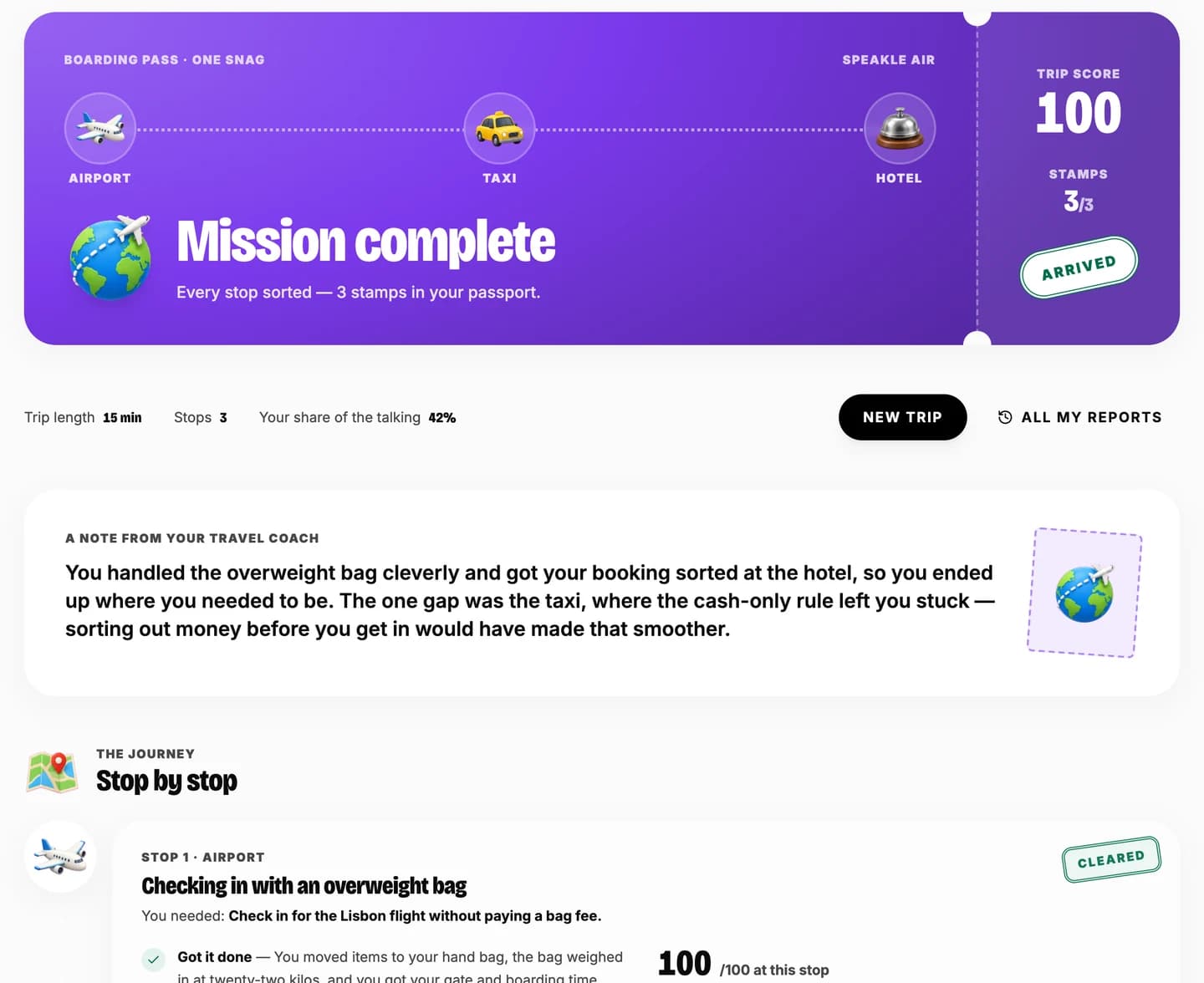
One situation, or a whole trip from the airport to the taxi to the hotel. Each stop earns a stamp when you got what you needed. The report shows the moments you checked back, handled a snag or got stuck, with the phrase that would have got you through, and the stamps build a passport across trips.
Translation, drawn as a climb
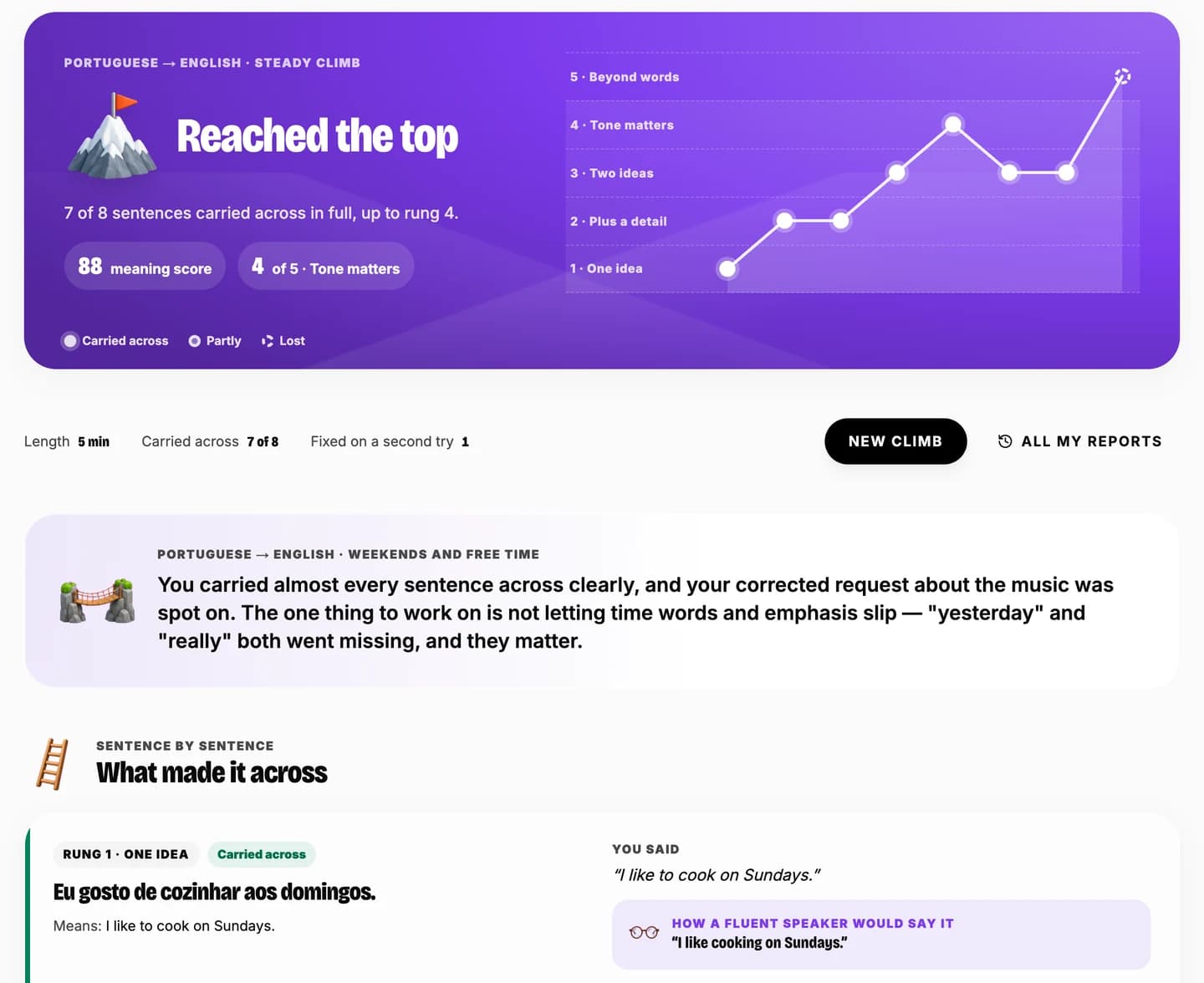
The coach gives you sentences in your own language, climbing from a single idea to tone and nuance. The report draws the climb, shows what meaning made it across into English and what got lost on the way (a joke, an idiom, a tone), and your next session opens with the sentences you missed.
Free conversation, with nobody keeping score
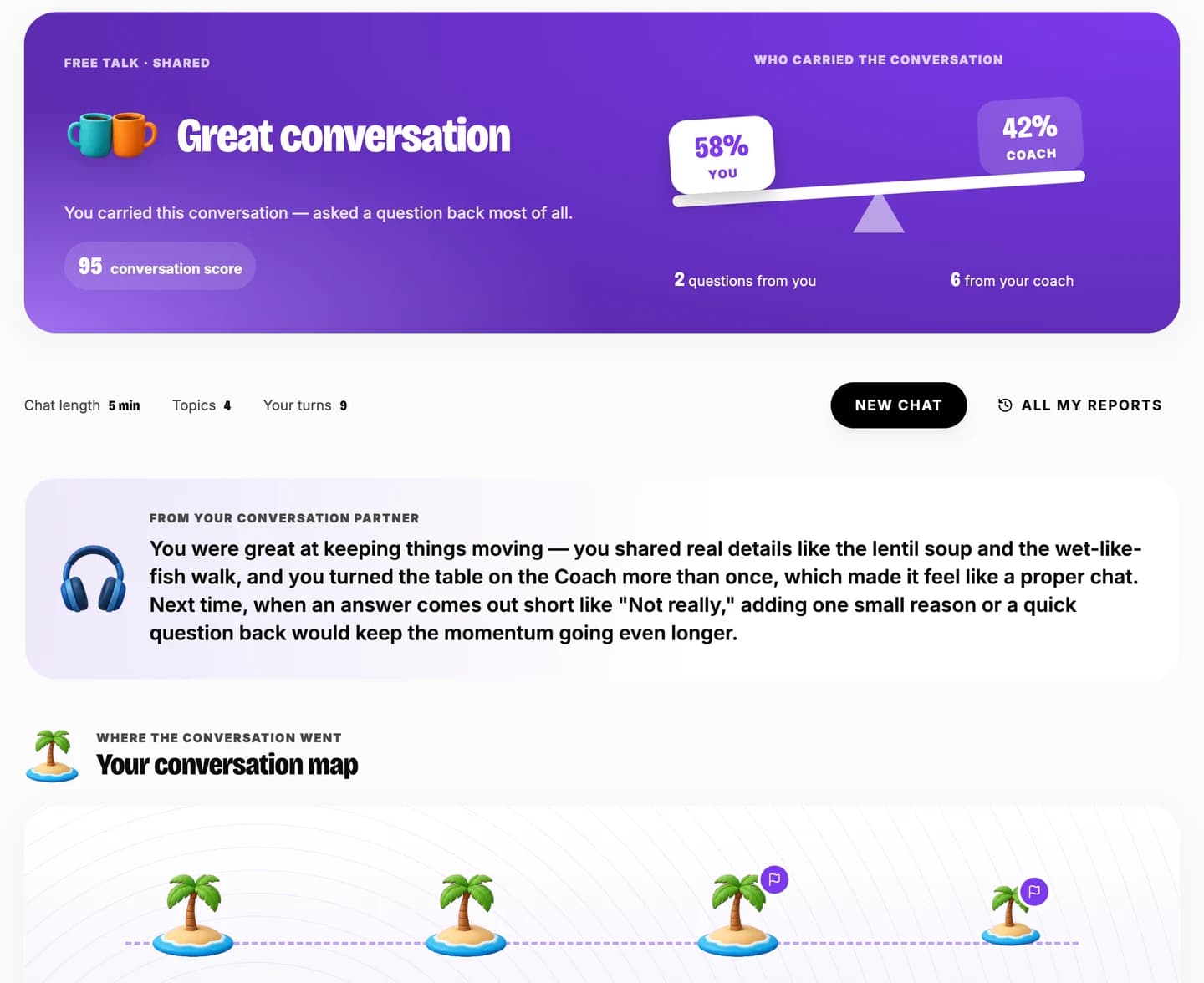
No winner, just how the conversation went. You see who carried it, which topics you started yourself, how deep you went, the moments where one more sentence would have kept it going, and a few ways to open a conversation about the thing you clearly enjoyed talking about.
IELTS speaking, under exam conditions
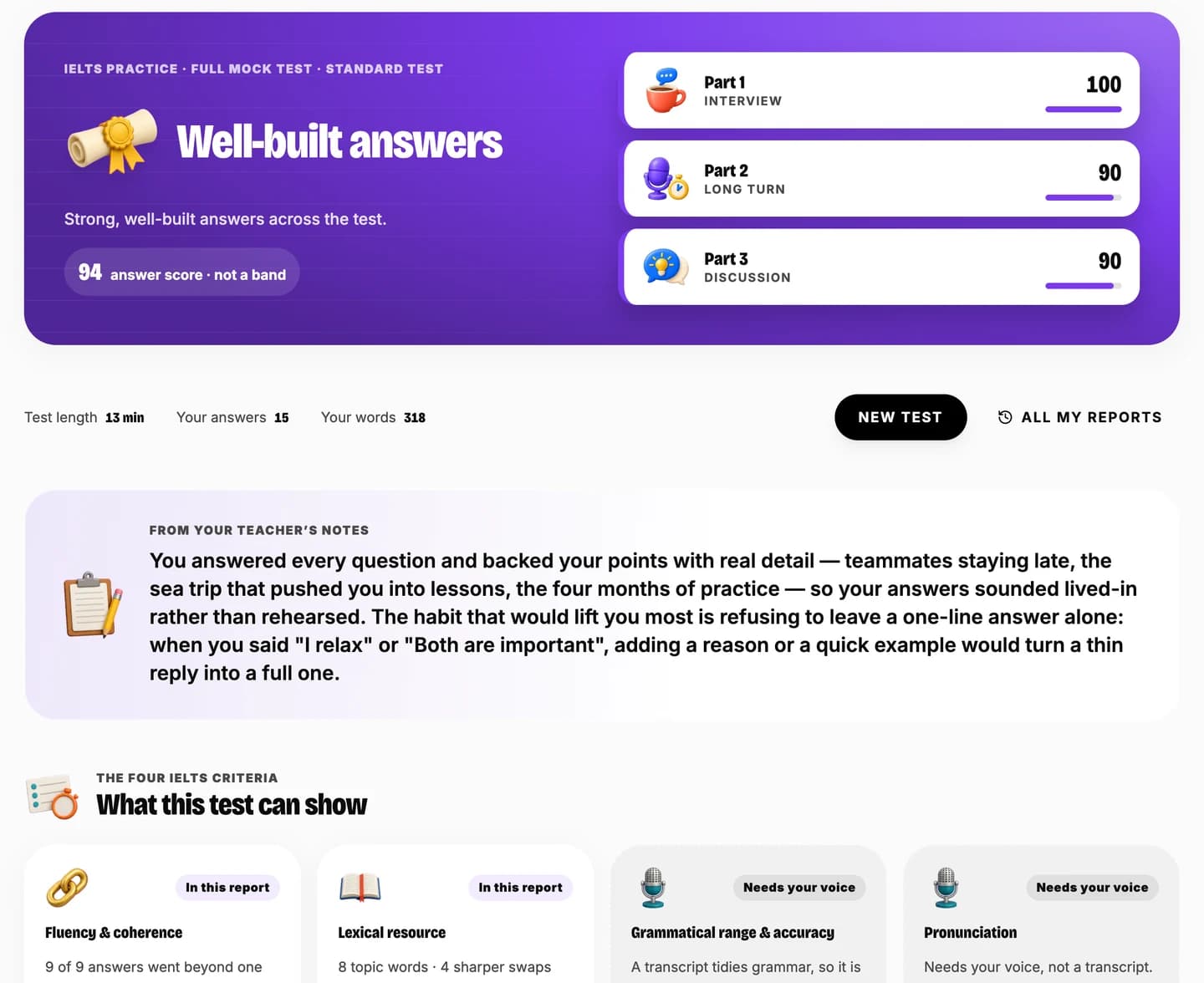
The examiner runs the test the way the real one does, part by part, with no feedback during it. The report shows how you built your answers. You see how far each Part 1 answer went, the cue card ticked off point by point with the length of your long turn, and the reasoning moves you made in Part 3. It also shows your linking phrases and your thinnest answers rewritten stronger. It deliberately gives no band: a band also needs grammar and pronunciation, which a transcript cannot show fairly.
Quietly harder as you get better
Each kind of call has its own level, and you are never shown it during the call. Two strong results in a row and the next one is a notch harder: a sharper opponent, a more demanding interviewer, a tougher Part 3. Three weak calls in a row that ran their full length ease it back. Nobody announces it; you just notice the conversations getting harder.
Every report, kept
Every report is kept. You can download it as a PDF, share a result card, and see your recent scores in each kind of call as a trend.
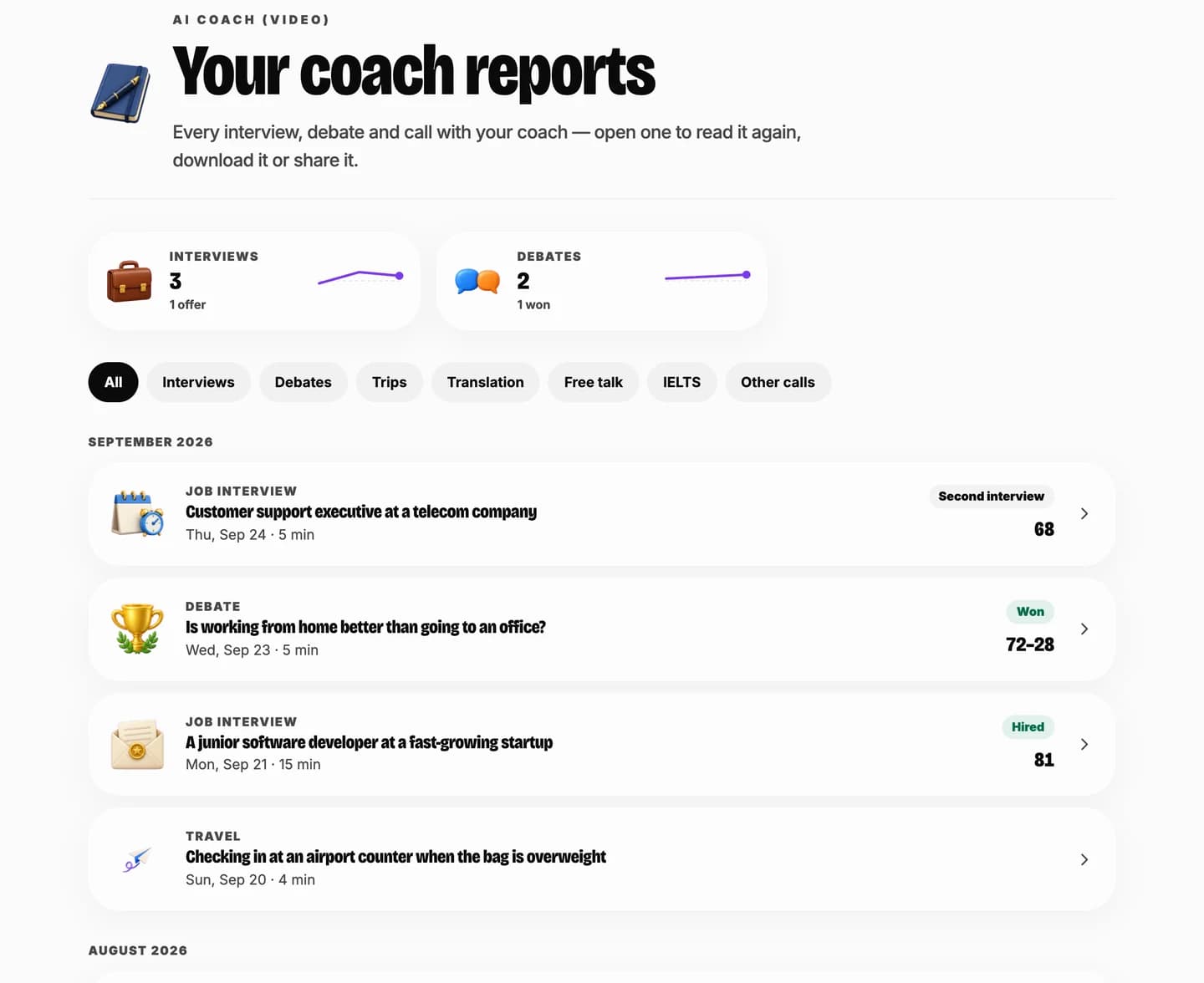
The progress page brings them together: interview offers over time, your debate record, and a logbook of every kind of conversation you have practised.
Pronunciation, ordered by the language you already speak
Most pronunciation courses teach every learner the same sounds in the same order. That is close to useless: an Arabic speaker has had both TH sounds since childhood and has never needed a /p/, while a Japanese speaker needs the L and R contrast before anything else.
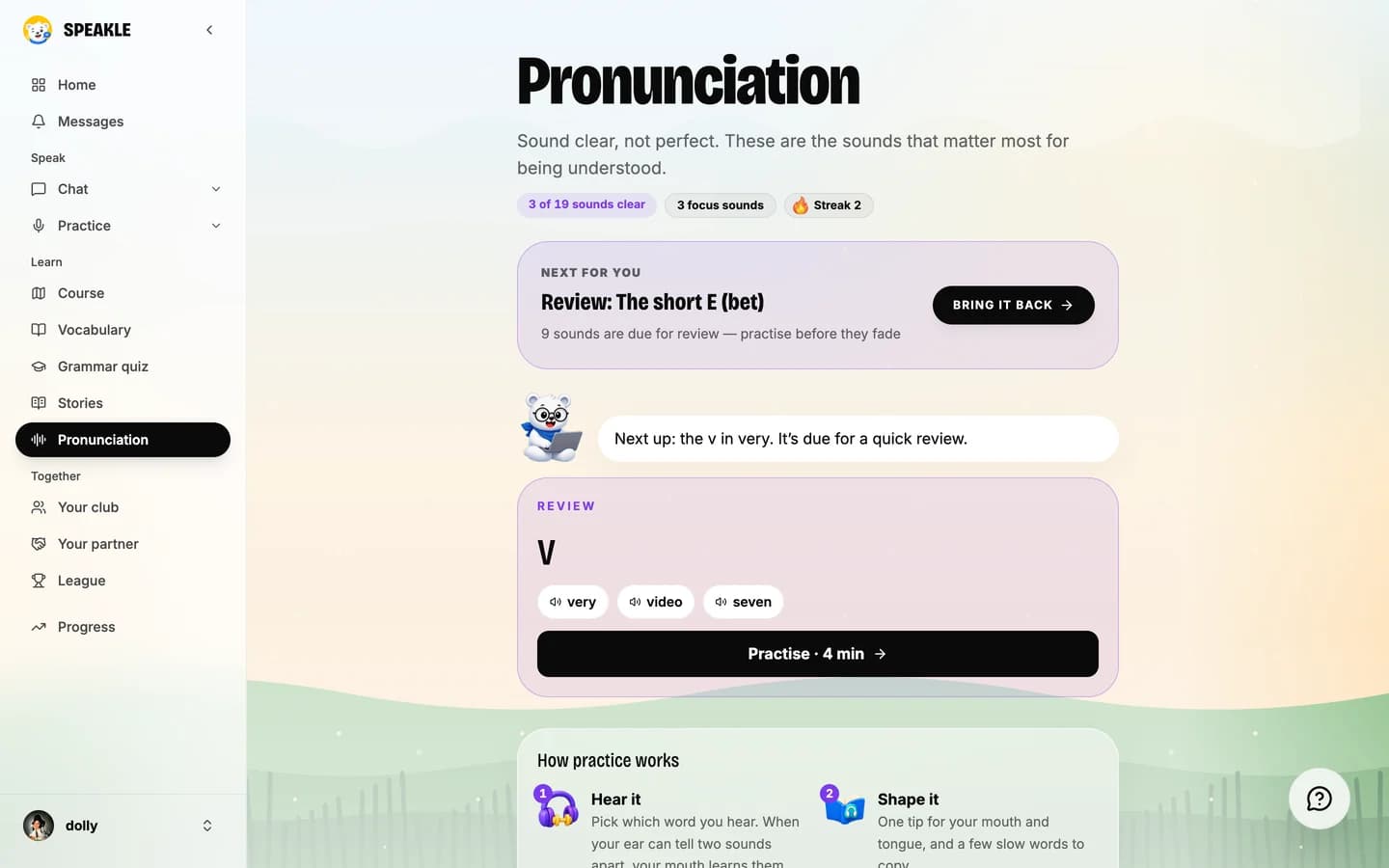
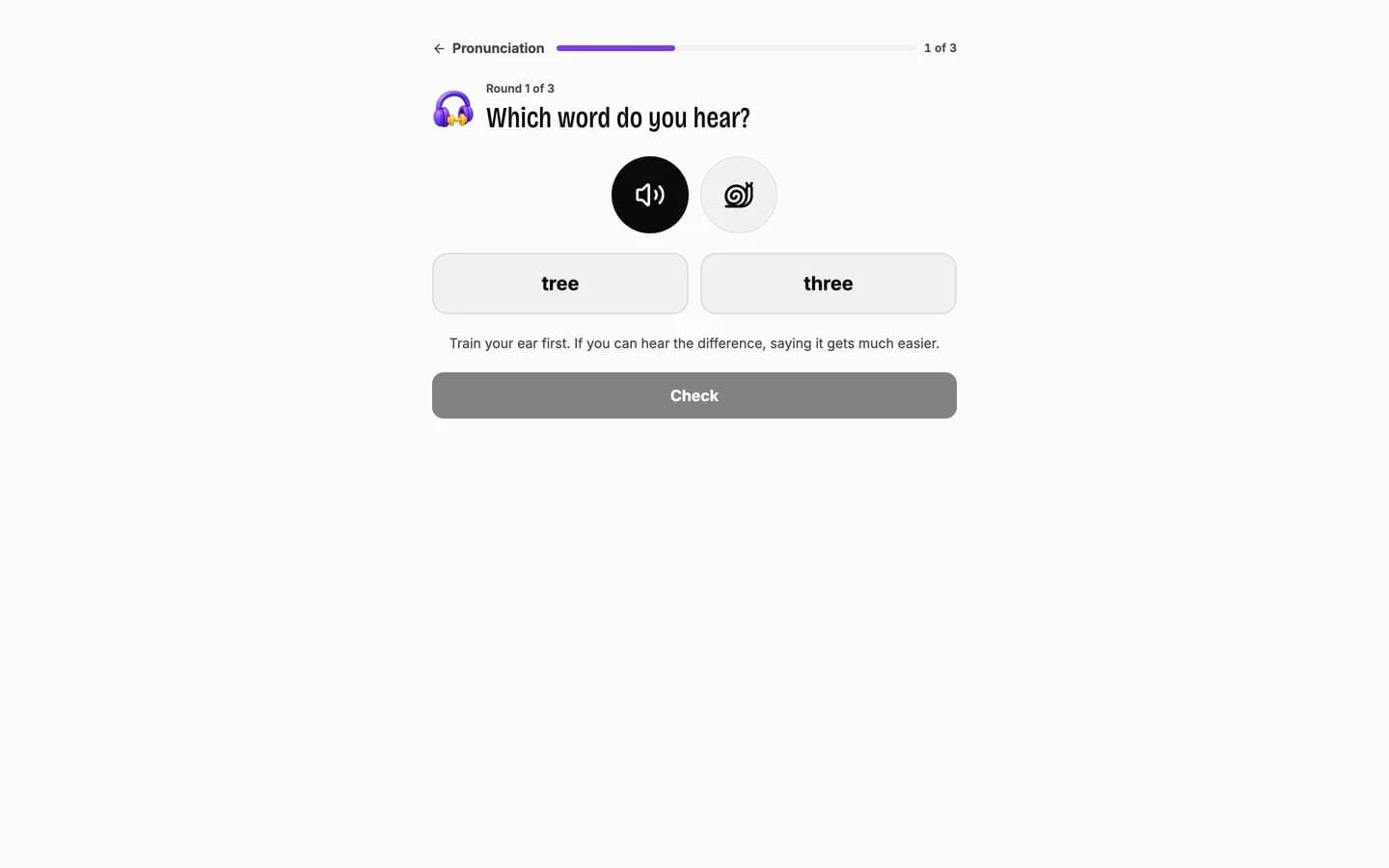
Speakle builds your path from your first language. Sounds it merges come first; sounds it already gives you are dropped entirely. Each one is worked in the order that makes it stick: hear the difference, then say it, then use it in words, then in your own free speech. There is a page for each of the eleven languages setting out exactly which contrasts it collapses and why.
Sounds are named the way a teacher names them, by a word you already know, rather than as phonetic symbols, unless you turn symbols on.
Keep talking until you run out
The Extempore Marathon is the opposite of the one-minute session: one topic, and you keep going for as long as you can, up to twenty-five minutes.
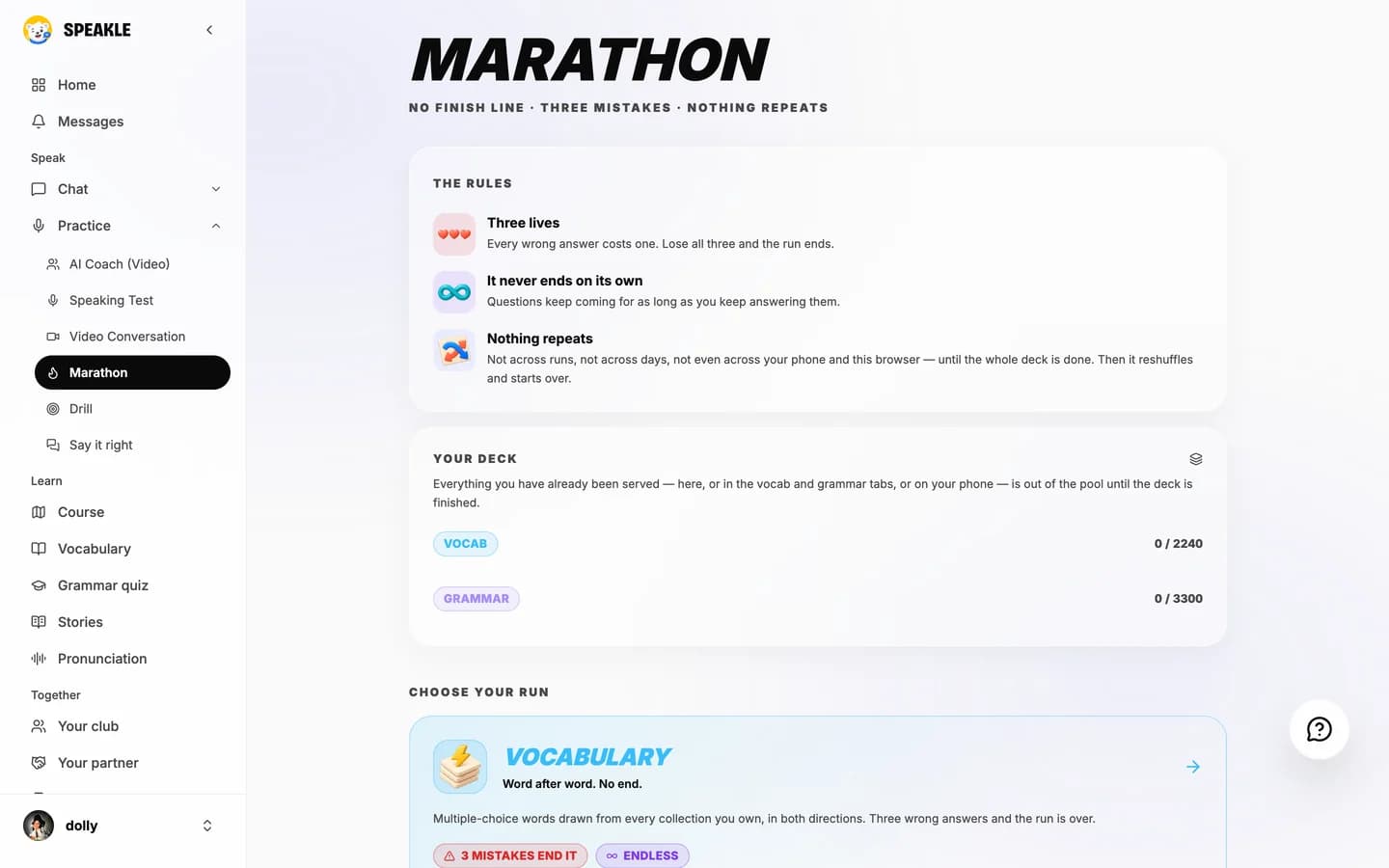
It trains what happens after your prepared material runs out. That is the moment real conversations break down, and it is almost impossible to rehearse on your own.
Talk to another learner, then get coached on it
Video conversation matches you with another learner at your level for about ten minutes, then coaches you both on what you actually said.
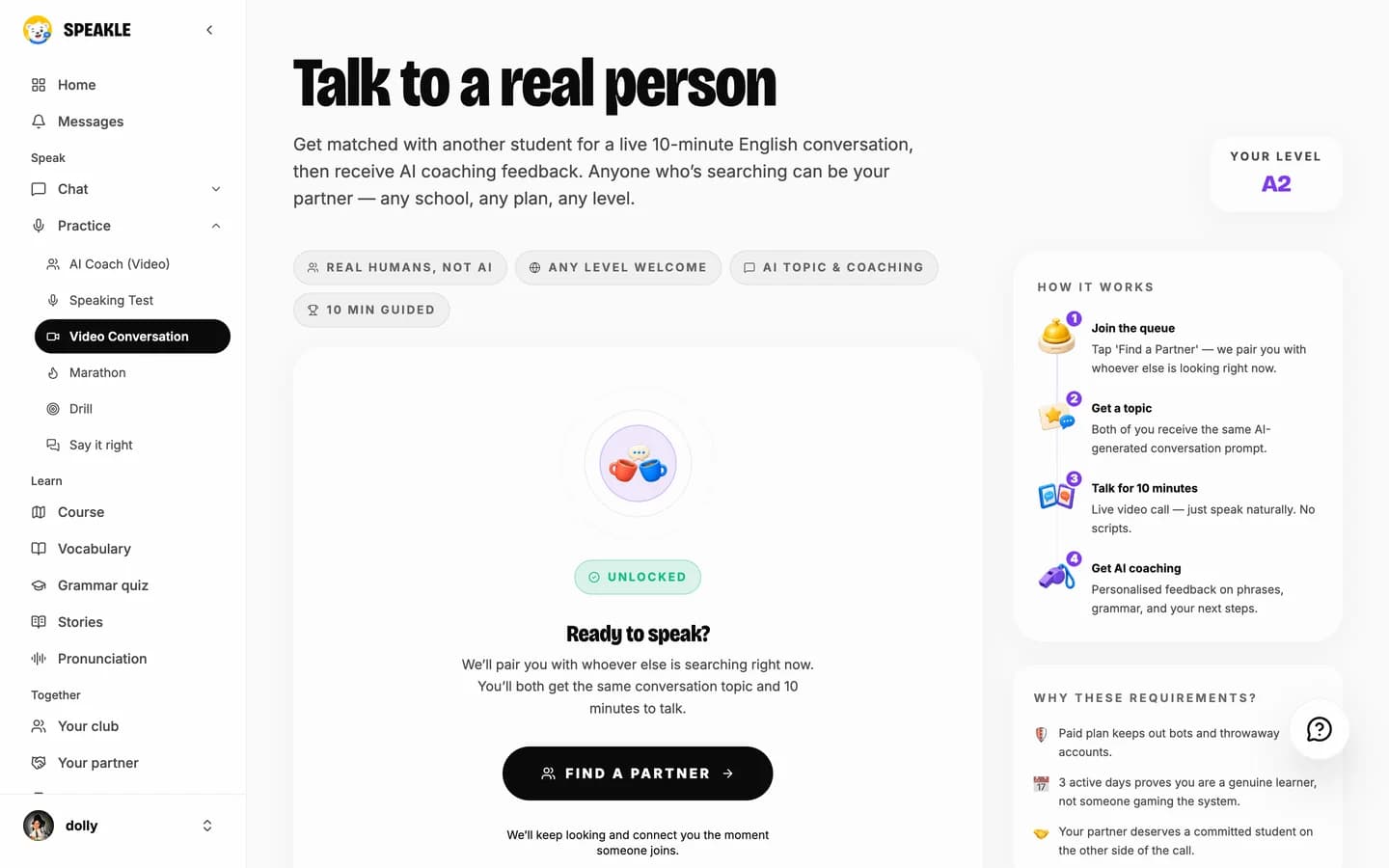
An AI partner is patient and never judges you, which is exactly why it cannot fully prepare you for a person who interrupts, changes the subject and does not slow down. This is the bridge between the two.
Stories you have to retell
Listen to a short story at your level, then say it back in your own words. The retelling is scored, which turns listening practice into speaking practice.
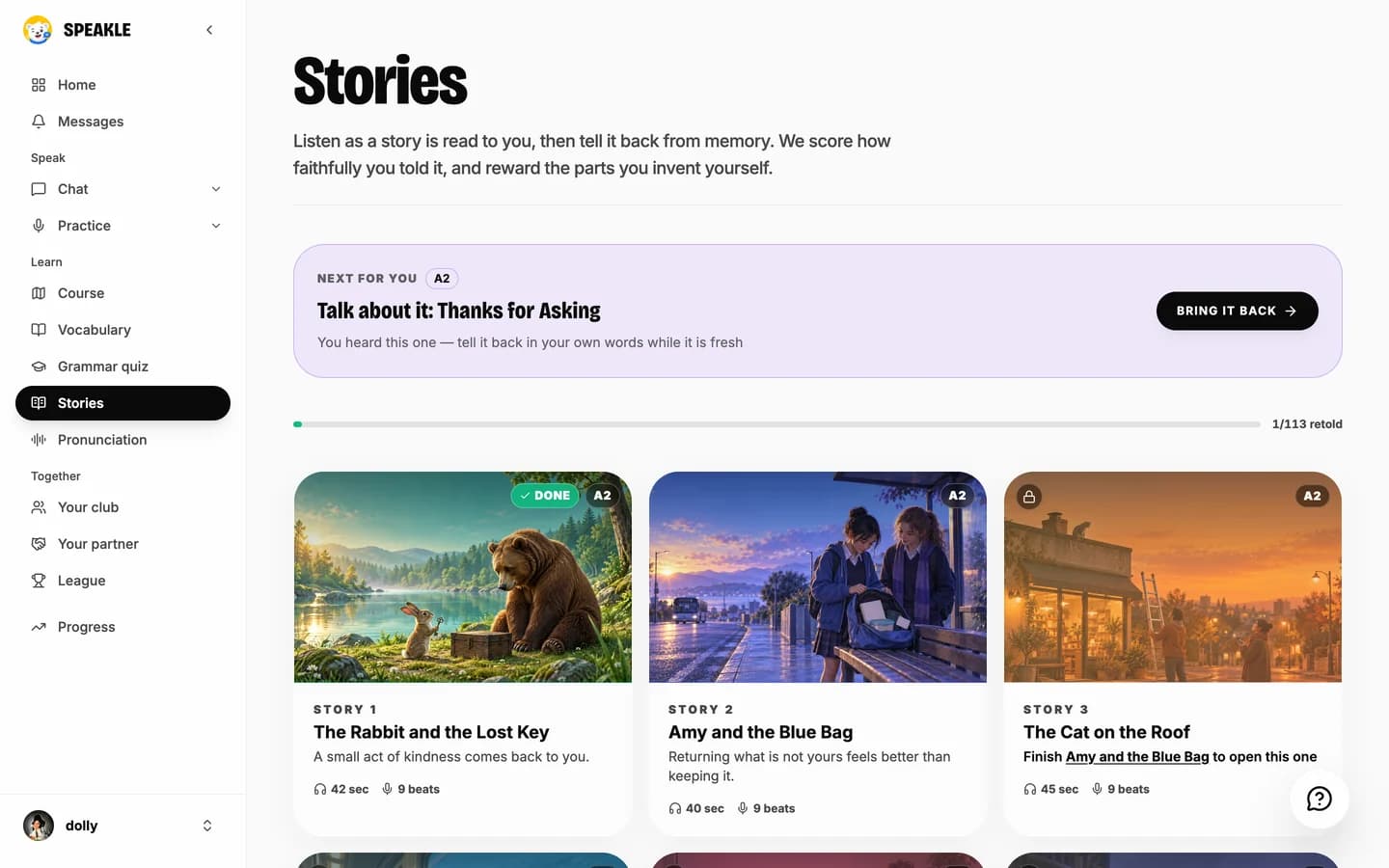
Retelling is a harder test than answering questions about a story and a much better one: you cannot do it by recognising the right option, only by producing the language yourself.
Vocabulary you meet, not vocabulary you are given
Tap any word you hear anywhere in the app to keep it. Your own words come back for review before you forget them, alongside collections grouped by level and topic.
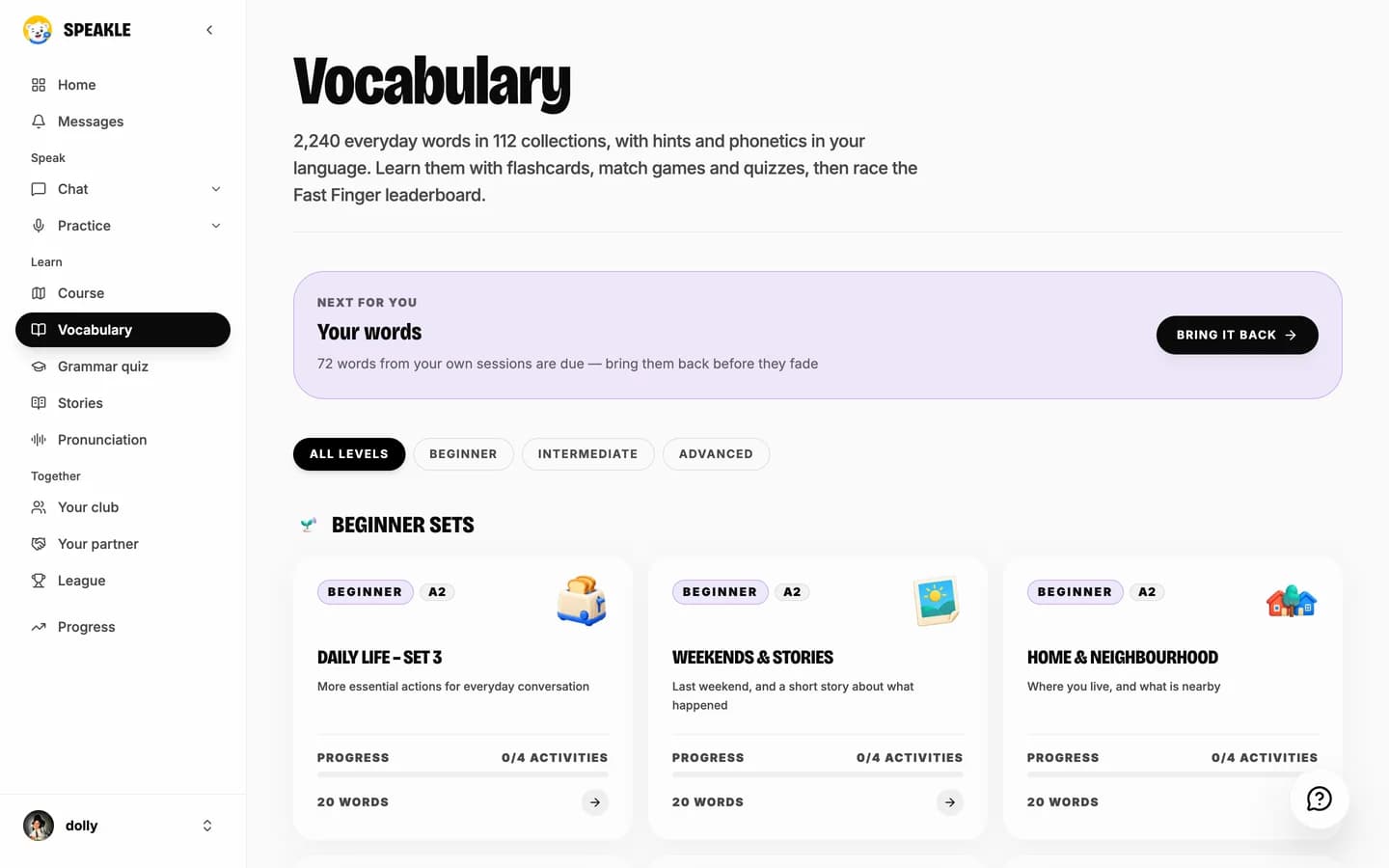
Definitions and examples are written in a small, simple defining vocabulary, so a word is never explained with three words harder than the one you looked up.
Grammar aimed at your own mistakes
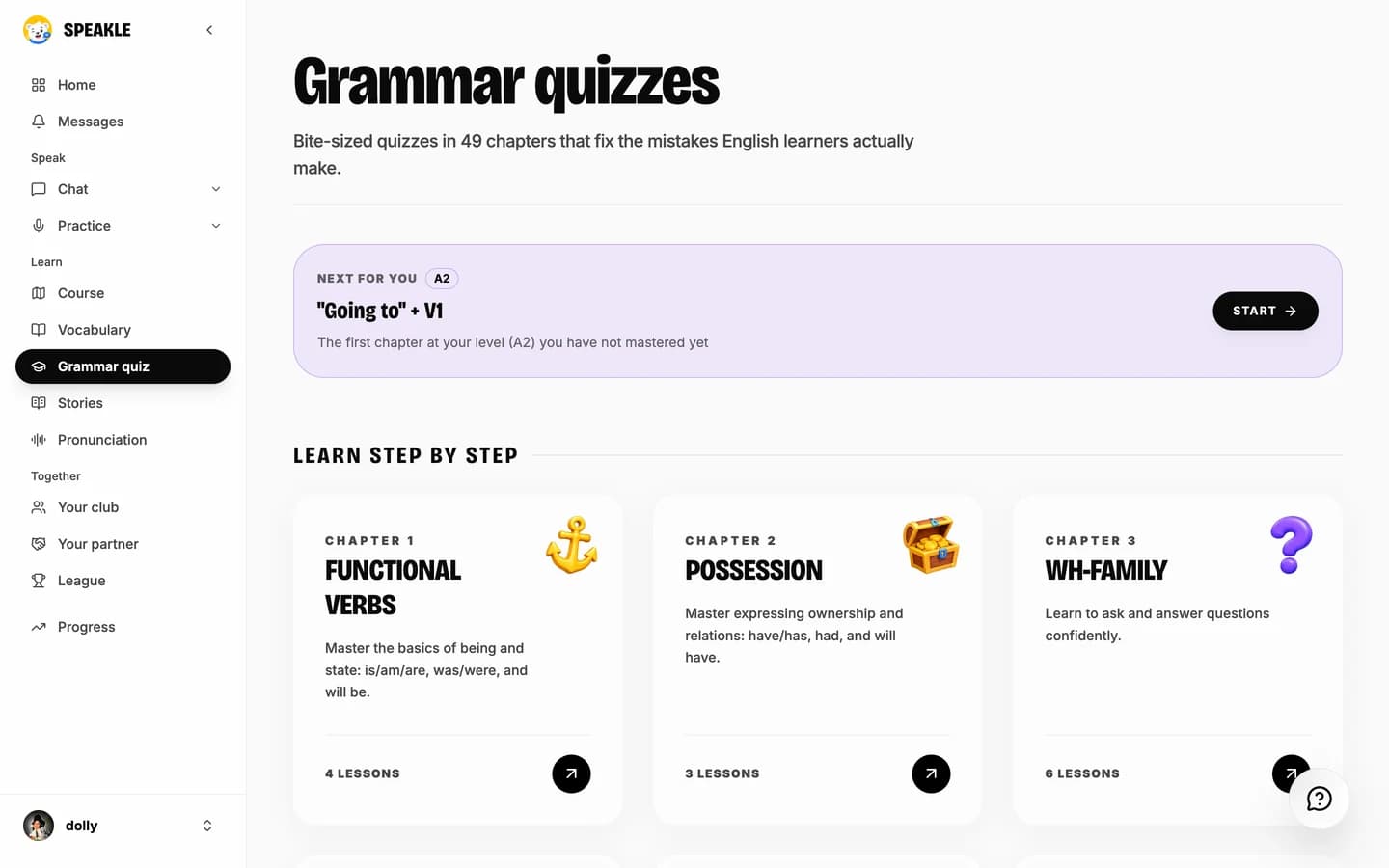
Grammar chapters with quizzes, and explanations in your own language when you want them, because the moment you need your first language is the moment English has already stopped working.
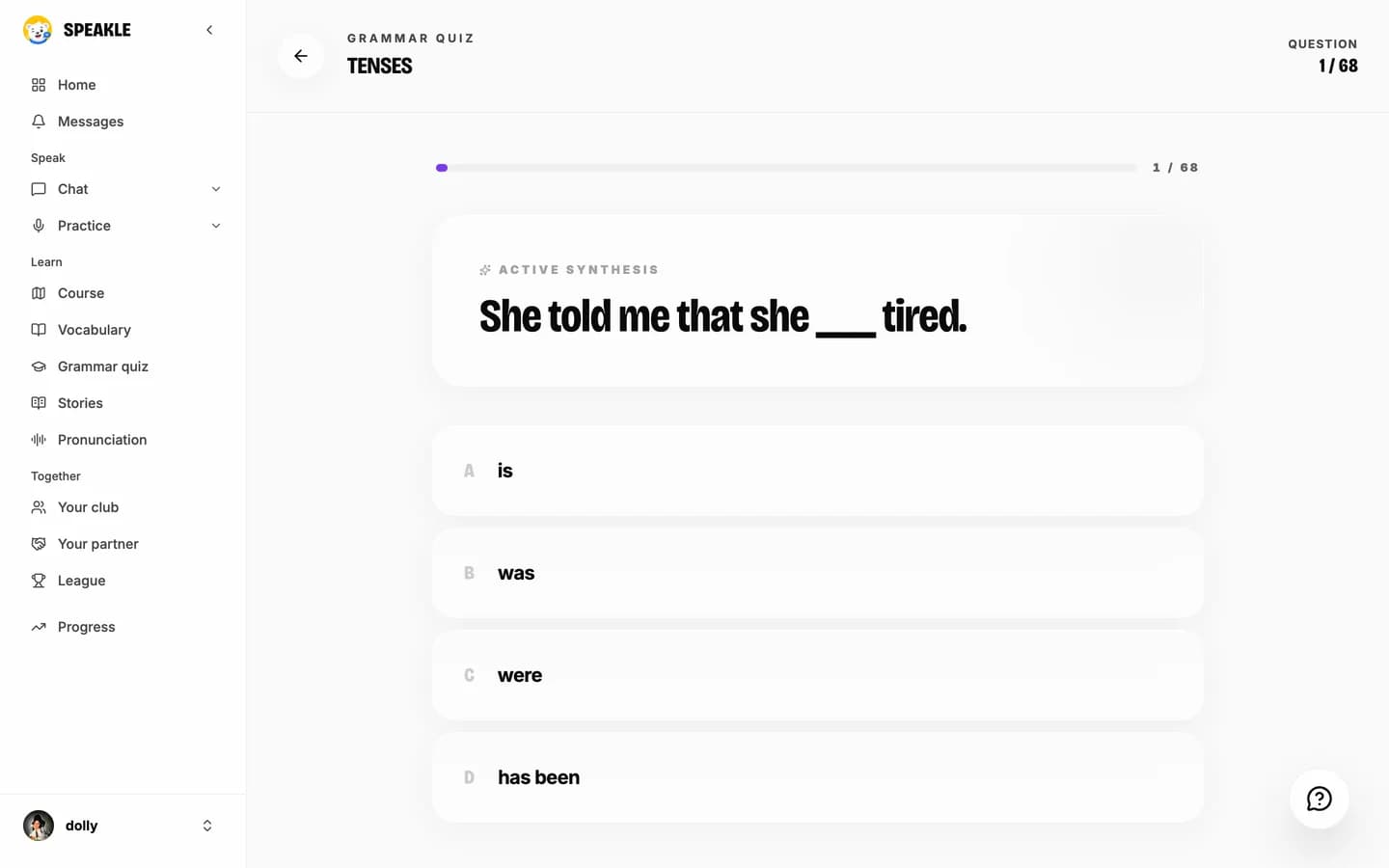
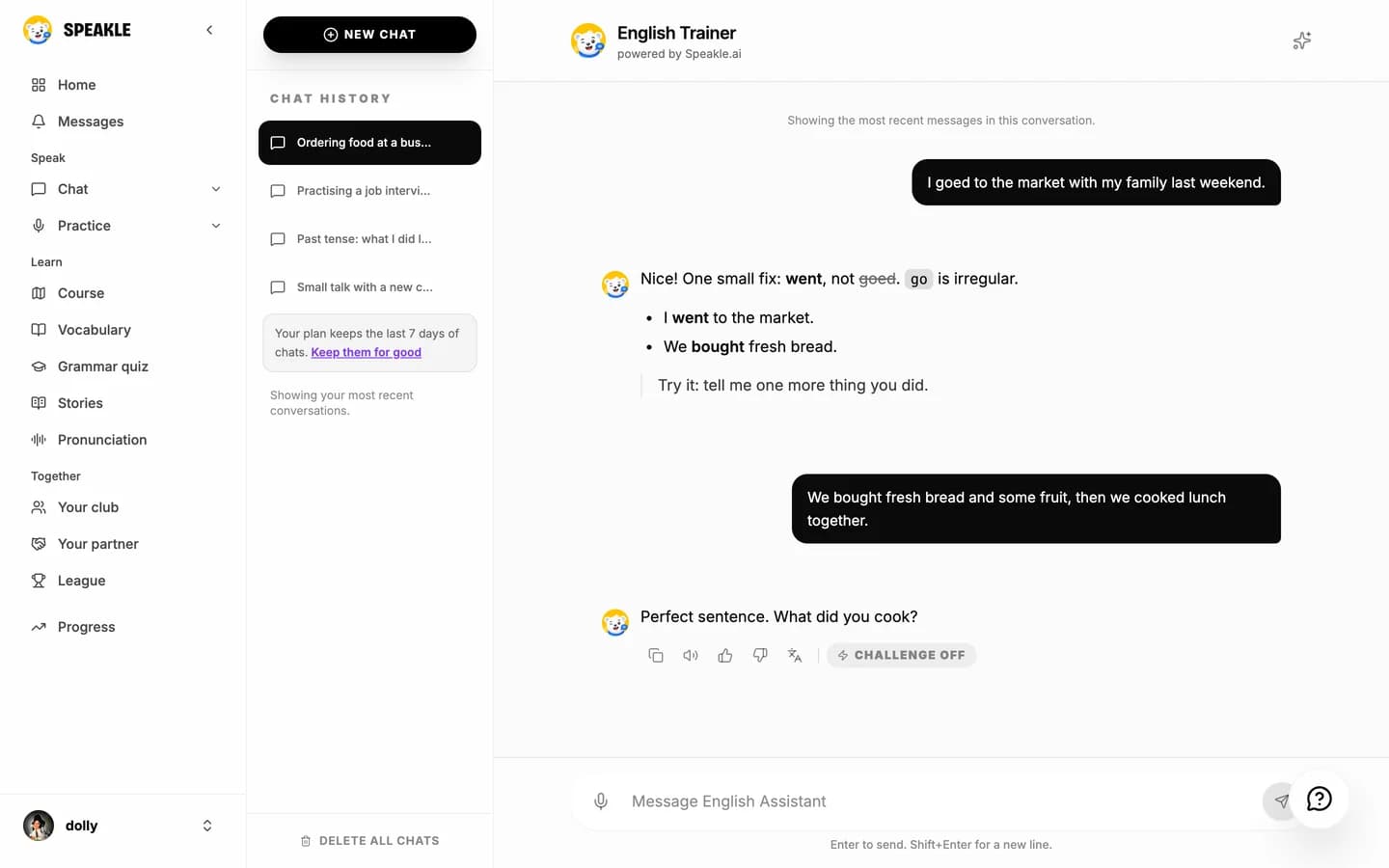
The same applies when you chat with the AI coach, by voice or by typing. A mistake is corrected in the reply, shown against what you actually wrote, and followed by a prompt to use the right form straight away, because a correction you use at once is the one that sticks.
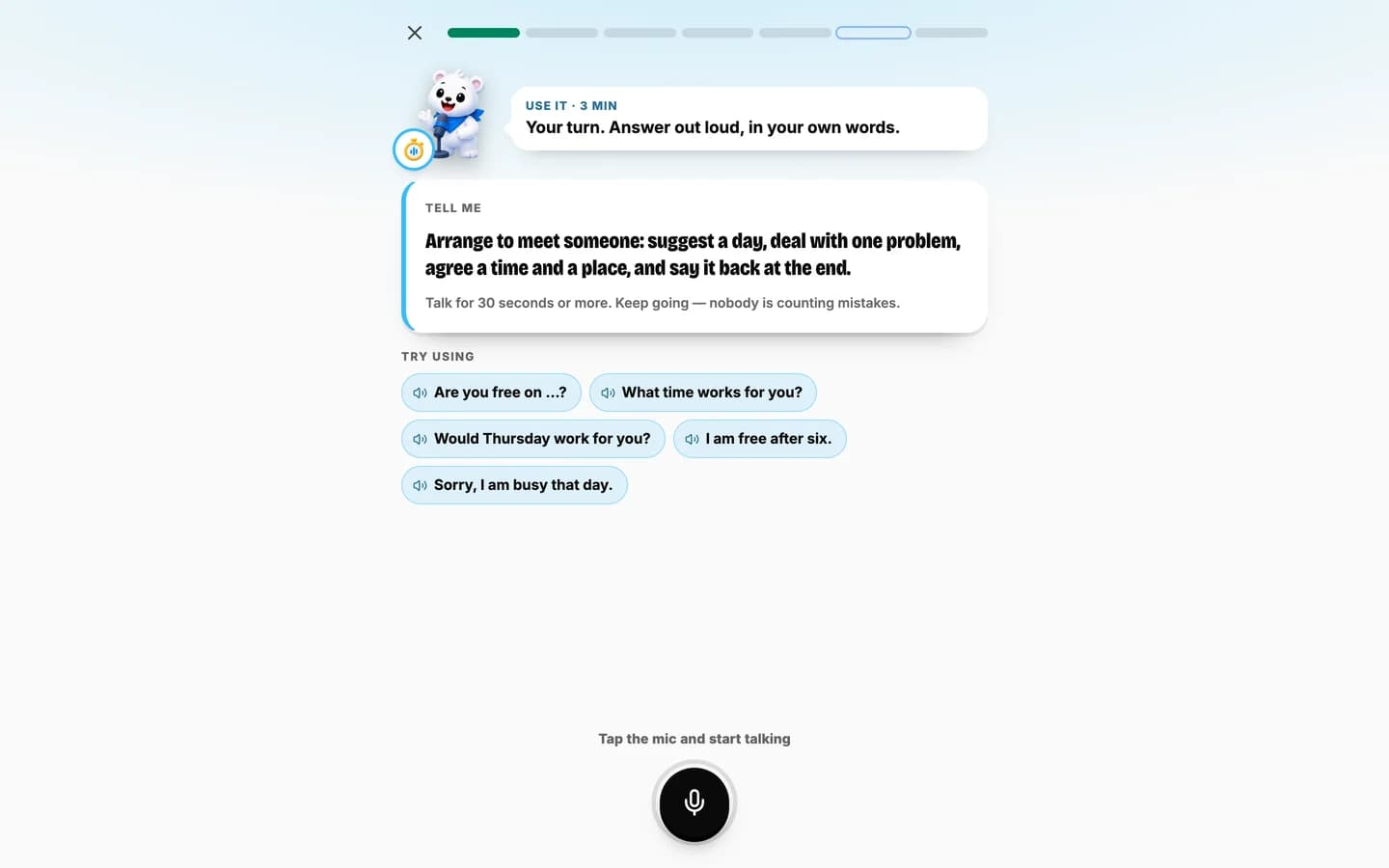
A course where every step is something you say
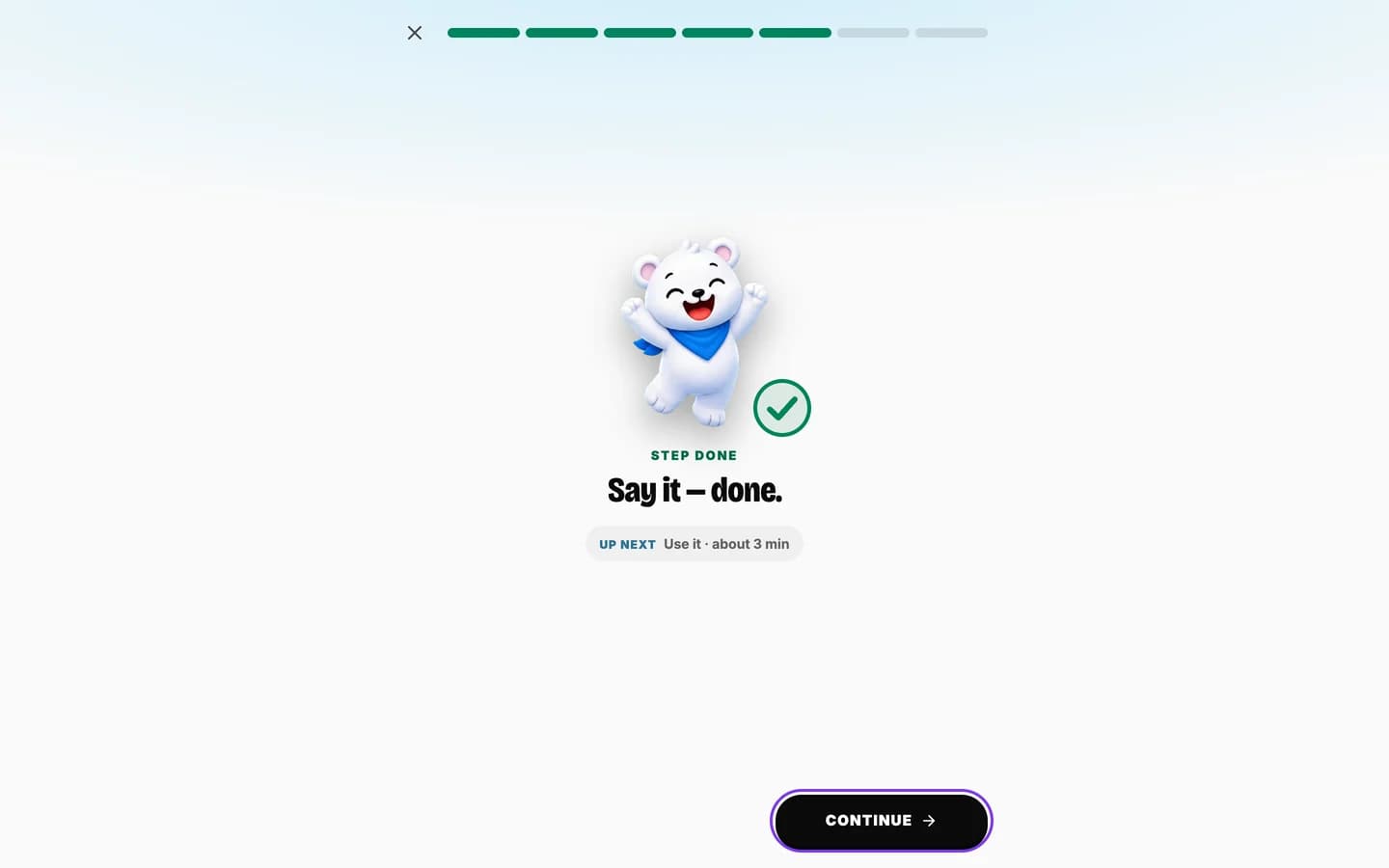
The course runs from your first words to fluent, and every unit is something you can say out loud rather than a topic you have read about. The spoken level check places you on it, so you start where you actually are. Each step is one real task: a warm-up, the words, the form, then your turn to say it in your own words.
Seeing that it is working
Progress is the part most apps get wrong, because a rising score is both the easiest thing to show and the least convincing.
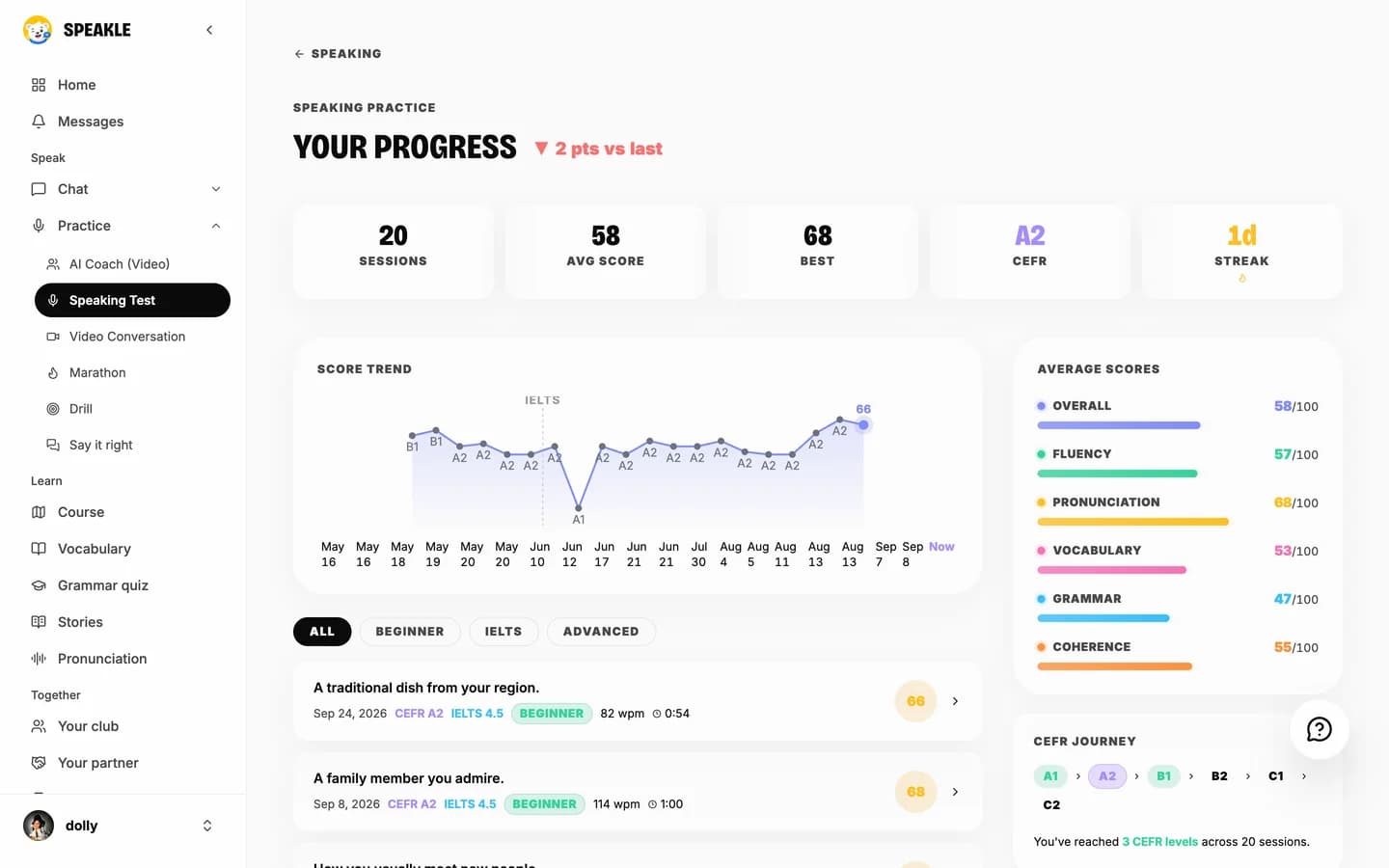
Alongside the trend you get your session history, the mistakes you have stopped making, and your own recordings over time. The recordings are the honest measure. A number going up is easy to doubt on a bad day; hearing what you sounded like two months ago is not.
In eleven languages, for more than twenty-five countries
Hints, corrections and explanations come in Arabic, Hindi, Japanese, Korean, Malay, Thai, Vietnamese, Turkish, Portuguese, Spanish or Italian. The interface language and the explanation language are set separately, so you can use the app in English and still have a mistake explained in your own language, which is what most people actually want.
Correction strictness is a setting, not a personality: light, balanced or strict, and you can change it any time. Every mistake is still found and saved either way; the setting only decides how much is put in front of you in the moment.
What it does not do
Worth saying plainly, because comparison pages that only list strengths are not useful.
Speakle is not a beginner course. If you cannot yet build a simple sentence, a vocabulary app will serve you better first, and you can come back.
It does not issue credentials. The CEFR level and IELTS band are software estimates for tracking your own progress, not results anyone else will accept. How the scoring works and where it is unreliable is written out in full.
It does not replace a human teacher for anything requiring judgement about people, and its speech recognition is not perfect, which is why every session shows you the transcript it scored rather than only a number.
Start in the next minute
The free speaking test needs no account: speak for about a minute and see your level and your first thing to fix. If you like what you see, create a free account. The free plan includes a scored session every day, daily AI chat, the first grammar chapters and a first story, with no card.
Comparing options first is sensible. There is an honest comparison of Speakle with the other apps in the category, including the cases where something else is the better choice.